2025年5月12日星期一

2024年11月11日星期一
2024年10月20日星期日
2024年10月2日星期三
2024年7月3日星期三
2022年12月28日星期三
2020年3月12日星期四
The 4000 Islands by Kayak
The 4000 Islands by Kayak

The 4000 Islands in southern Laos, low lying sandy clumps in the Mekong River, are famous for their easy-going pace, banana pancakes, afternoons in hammocks, dolphin-spotting opportunities, wide-sky sunsets, and raucous parties.
I’ve cycled over traces of the old French railway tracks through mango and teak forests, walked the slow loop of sandy trails wriggling through the islands’ small communities, and flitted about from one vestige of French power to another, to bar, to café, and guesthouse many times. I’d never considered taking to the water, though, until now.
The Mekong River can look formidable at times – a fast-flowing wide milk chocolate brown river cut with rocky islands and drowned trees. But a kayaking trip sounded exciting, and with a chance to spot the area’s rare Irrawaddy dolphins, too, I eagerly signed up.
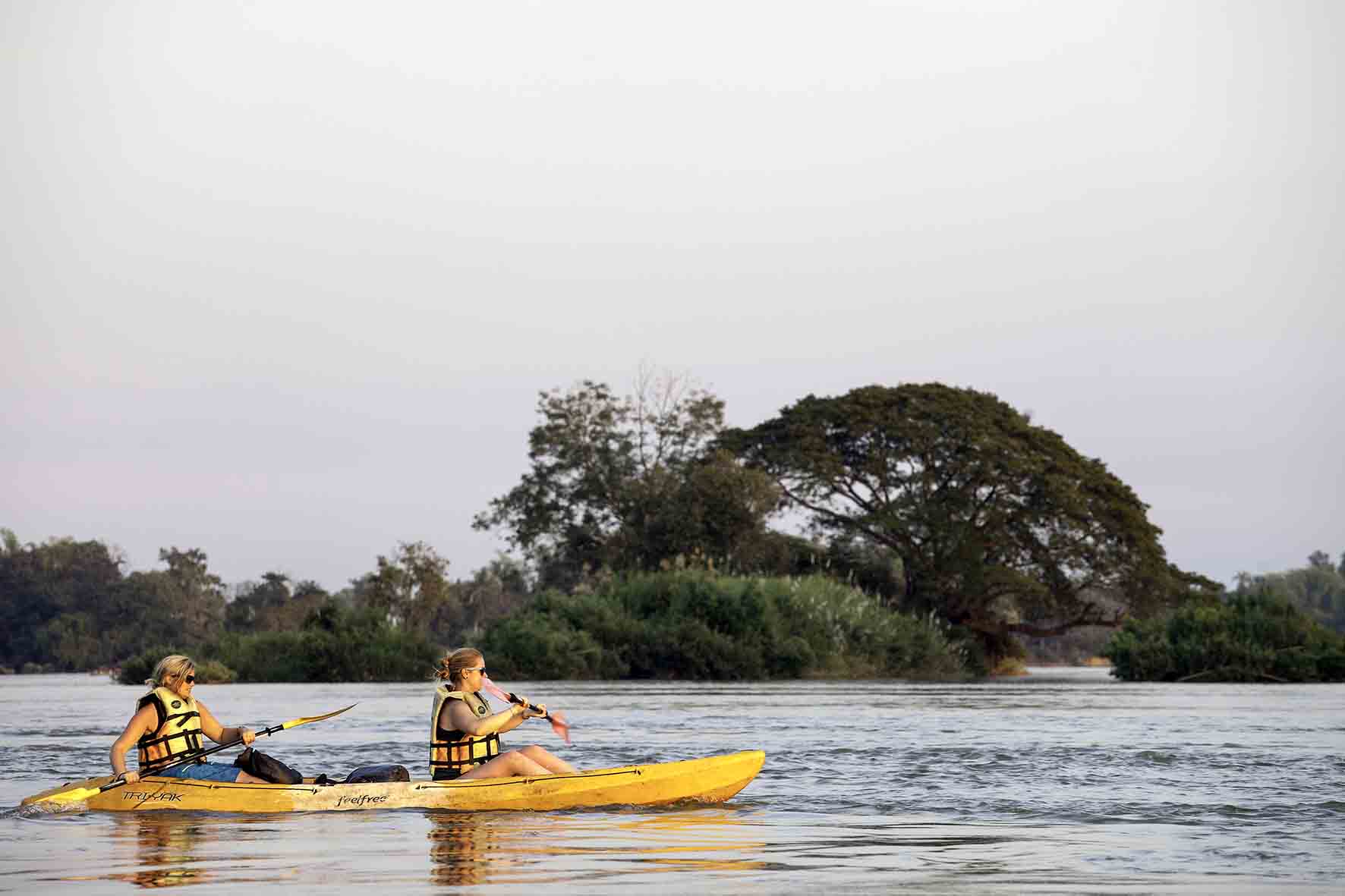
Green Paradise’s kayaking expedition wisely includes free breakfast for its mainly land-lubber clientele. After fuelling up with baguette, egg, and thick Lao coffee at a restaurant on Don Det island, we grabbed life jackets and tucked into our kayaks. Hoping to halve the work of paddling, I jumped into a kayak with our guide, Mr. Sam.
V Patient Mr. Sam spent a good deal of time barking ‘right, right’ as our crew of 21 – Brits, Australians, Dutch, French, and Hungarians – took to the water like ducks, I mean clumsy humans, grappling with kayak balance, water flow, and huge thickets of vegetation that reared up unexpectedly.
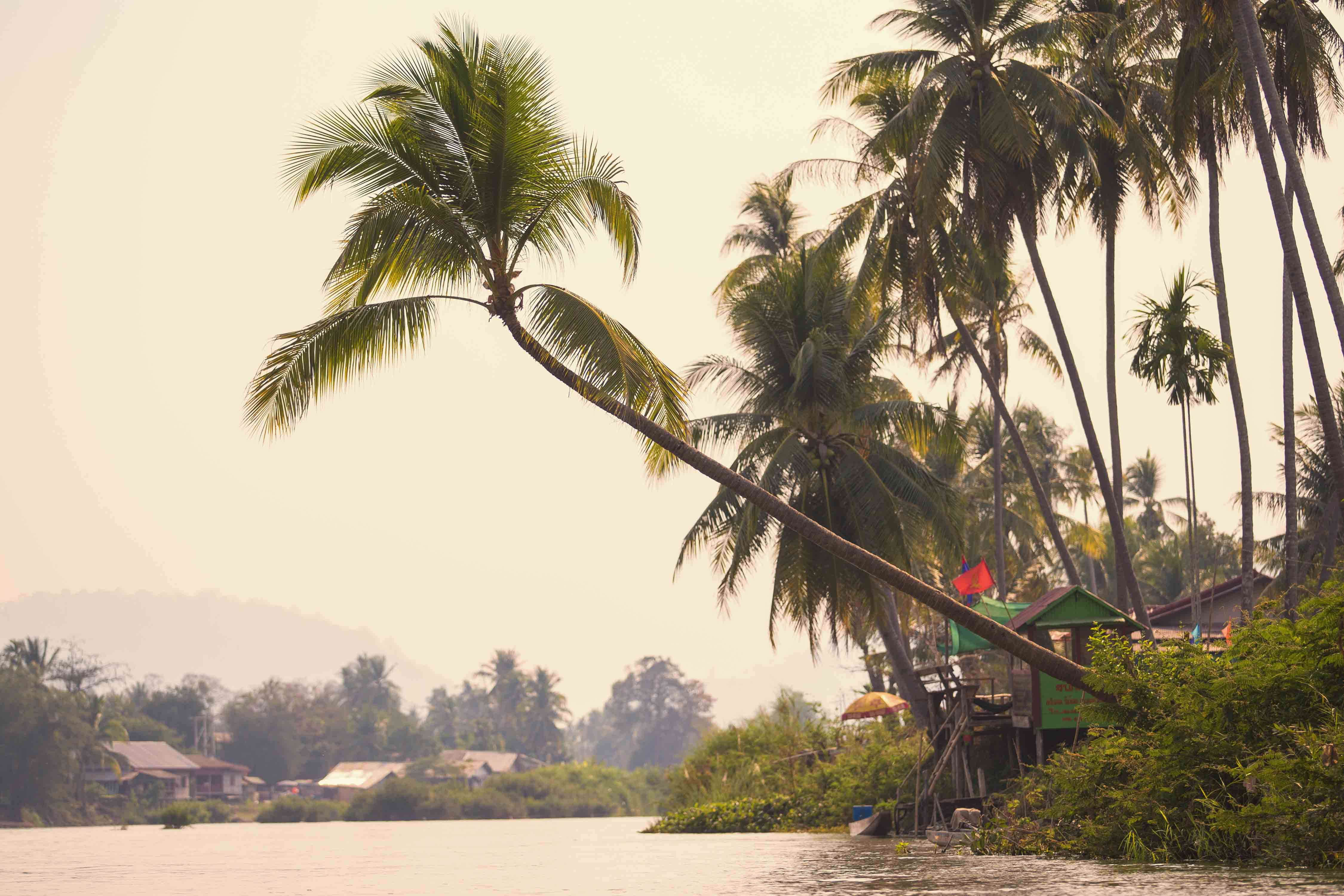
Our first destination was downstream at Don Khone Island’s Pa Soi rapids. Early on we temporarily lost part of the group, one kayak team fell into the river, and one kayak got sucked into a cluster of bushes and became entangled. The heat was unforgiving but we giggled at these mishaps and continued on our journey navigating clumps of trees and mini islands. We parked up just before Pa Soi rapids and walked over a bridge to look at the frothing water below.
The kayaks had been moved beyond Pa Soi Falls to a safe spot; we boarded them again for a journey to the bottom of Khone Island. At Hang Khone village, at the tip of Khone Island, we packed into a longtail boat to head upstream in search of the critically endangered Irrawaddy dolphin. We clambered up the sandy hill of a large island and looked across the stream of the fast-flowing river. The dolphins, their wet skin glistening in the sun, surfaced and ducked as they searched for fish in the food-rich pools. It was thrilling to catch a glimpse of these rare mammals. The WWF reports there’s been a slight increase in their numbers in the Mekong in Cambodia from 80 in 2015 to 92 in 2017 but not in Laos. In the Lao Mekong, there are just three. While munching on a lunch of baguette, chicken, and fried rice we saw all three of them about 30 to 40 times – all fins, snouts, sleek metal-grey bodies gleaming in the strong sun.
Back at Khone Island we fetched our kayaks and headed out downriver to a pickup point on the mainland at Ban Veunkham. The sun was crippling but, like a miracle, there on the riverbank at Ban Veunkham was a stall with a packed icebox. We cleaned it out of Beerlao and Coke before boarding a truck to visit the mother of all waterfalls – the kilometers-wide Khone Phapheng Falls.
At first sight, you can see why it defeated French colonial explorers. It’s a seething, frothing mass of thundering water swirling over sturdy boulders as it fights to enter Cambodia and the lower Mekong. The French found themselves in these parts when they were shoring up claims to the river and their Indochina colonies. The French needed to move gunboats into position to defend new territorial claims but navigating past the raging Khone Phapheng Falls – with its 21-meter drop – had defeated French minds. They built a railway across Khone Island, directly west of the Phapheng Falls, so two gunboats could be hauled across it; the railway infrastructure (some of which we saw at Hang Khone village) was later adapted for commercial traffic with steamboats on the river thrown into the mix. When roads were built in the 1930s the railway fell into disuse. Today, rusty locomotives stand abandoned at the edge of paddy fields, the last tangible remnants of island railway traffic.
After ice cream – more energy – we boarded our kayaks at Nakasang village to paddle downstream and back to Don Det Island. As the rose-pink sun began to set, the light was beautiful, the water appeared like silk, clumps of greenery took on a velvet glow, and fishermen were pootling about in pirogues.
Of course, after so much exercise, we replenished our muscles with more sundowner Beerlao as soon as we clambered back on to dry land!
GETTING THERE
Lao Airlines has daily flights to Pakse from Vientiane, Luang Prabang, and Bangkok. The 4000 Islands are 3 hours south of Pakse by road.
~The Laotian Times~
The 4000 Islands in southern Laos, low lying sandy clumps in the Mekong River, are famous for their easy-going pace, banana pancakes, afternoons in hammocks, dolphin-spotting opportunities, wide-sky sunsets, and raucous parties.
I’ve cycled over traces of the old French railway tracks through mango and teak forests, walked the slow loop of sandy trails wriggling through the islands’ small communities, and flitted about from one vestige of French power to another, to bar, to café, and guesthouse many times. I’d never considered taking to the water, though, until now.
The Mekong River can look formidable at times – a fast-flowing wide milk chocolate brown river cut with rocky islands and drowned trees. But a kayaking trip sounded exciting, and with a chance to spot the area’s rare Irrawaddy dolphins, too, I eagerly signed up.
Green Paradise’s kayaking expedition wisely includes free breakfast for its mainly land-lubber clientele. After fuelling up with baguette, egg, and thick Lao coffee at a restaurant on Don Det island, we grabbed life jackets and tucked into our kayaks. Hoping to halve the work of paddling, I jumped into a kayak with our guide, Mr. Sam.
V Patient Mr. Sam spent a good deal of time barking ‘right, right’ as our crew of 21 – Brits, Australians, Dutch, French, and Hungarians – took to the water like ducks, I mean clumsy humans, grappling with kayak balance, water flow, and huge thickets of vegetation that reared up unexpectedly.
Our first destination was downstream at Don Khone Island’s Pa Soi rapids. Early on we temporarily lost part of the group, one kayak team fell into the river, and one kayak got sucked into a cluster of bushes and became entangled. The heat was unforgiving but we giggled at these mishaps and continued on our journey navigating clumps of trees and mini islands. We parked up just before Pa Soi rapids and walked over a bridge to look at the frothing water below.
The kayaks had been moved beyond Pa Soi Falls to a safe spot; we boarded them again for a journey to the bottom of Khone Island. At Hang Khone village, at the tip of Khone Island, we packed into a longtail boat to head upstream in search of the critically endangered Irrawaddy dolphin. We clambered up the sandy hill of a large island and looked across the stream of the fast-flowing river. The dolphins, their wet skin glistening in the sun, surfaced and ducked as they searched for fish in the food-rich pools. It was thrilling to catch a glimpse of these rare mammals. The WWF reports there’s been a slight increase in their numbers in the Mekong in Cambodia from 80 in 2015 to 92 in 2017 but not in Laos. In the Lao Mekong, there are just three. While munching on a lunch of baguette, chicken, and fried rice we saw all three of them about 30 to 40 times – all fins, snouts, sleek metal-grey bodies gleaming in the strong sun.
Back at Khone Island we fetched our kayaks and headed out downriver to a pickup point on the mainland at Ban Veunkham. The sun was crippling but, like a miracle, there on the riverbank at Ban Veunkham was a stall with a packed icebox. We cleaned it out of Beerlao and Coke before boarding a truck to visit the mother of all waterfalls – the kilometers-wide Khone Phapheng Falls.
At first sight, you can see why it defeated French colonial explorers. It’s a seething, frothing mass of thundering water swirling over sturdy boulders as it fights to enter Cambodia and the lower Mekong. The French found themselves in these parts when they were shoring up claims to the river and their Indochina colonies. The French needed to move gunboats into position to defend new territorial claims but navigating past the raging Khone Phapheng Falls – with its 21-meter drop – had defeated French minds. They built a railway across Khone Island, directly west of the Phapheng Falls, so two gunboats could be hauled across it; the railway infrastructure (some of which we saw at Hang Khone village) was later adapted for commercial traffic with steamboats on the river thrown into the mix. When roads were built in the 1930s the railway fell into disuse. Today, rusty locomotives stand abandoned at the edge of paddy fields, the last tangible remnants of island railway traffic.
After ice cream – more energy – we boarded our kayaks at Nakasang village to paddle downstream and back to Don Det Island. As the rose-pink sun began to set, the light was beautiful, the water appeared like silk, clumps of greenery took on a velvet glow, and fishermen were pootling about in pirogues.
Of course, after so much exercise, we replenished our muscles with more sundowner Beerlao as soon as we clambered back on to dry land!
GETTING THERE
Lao Airlines has daily flights to Pakse from Vientiane, Luang Prabang, and Bangkok. The 4000 Islands are 3 hours south of Pakse by road.
~The Laotian Times~
2018年1月14日星期日
Public park planned for city’s riverside
Public park planned for city’s riverside
Vientiane authorities have agreed to the creation of a green lung for city residents and visitors in the form of a public park along the Mekong River in Sisattanak district.
The 31,500 square metre site is located behind the Don Chan Palace hotel and adjoins Chao Anouvong park.
According to the concession agreement signed on Monday between Vientiane’s Planning and Investment Department and Kolao Resort Company, the company will have a 30 year concession on the site. It is estimated that the park will cost US$10 million to build.
Kolao Group President Dr Khamkhan Naphavong told Vientiane Times on Wednesday “We will start work on the park this month and expect it to officially open in the middle of next year.”
“Under an agreement signed in March 2014, the project consisted only of a parking area, but that changed with the addition of more investment activities and budget with the aim of creating a leisure park. We signed the new agreement on Monday after it was approved by the Vientiane Mayor on January 5.”
“When construction is complete, the park will have a parking area, swimming pool, exercise area, children’s playground, modern food court and shops with facilities designed to attract tourists that will also sell handicrafts,” he said.
“The model has been designed and now we have to make a few adjustments. I hope the park will become another place that is attractive to visitors and provides a space where people can relax,” Dr Khamkhan added.
The Kolao Resort Company is also interested in developing part of Don Chan island next to the current concession site, where they are thinking of building a recreational water park. The company is ready to go ahead with this if the Vientiane authorities approve.
When asked about how the public could help to promote Visit Laos Year, Dr Khamkhan said litter was a major problem in Vientiane and places like Chao Anouvong park needed better management of cleaning.
Given that Vientiane is the capital and should be the flagship of the country’s attractions, with the Mekong riverbank fast becoming a magnet for visitors, the city should do more to roll out a welcome mat for Visit Laos Year, he said.
One of the places that draws visitors to the riverbank is Chao Anouvong park, which is very popular with local residents and people from outside the city.
The park is not only a place where people can go to stroll or exercise as they gaze at the sunset, it also has a bustling night market where people can buy a wide range of items, have a snack or buy a drink as they while away the evening in a relaxed setting.
~News courtesy of Vientiane Times~
2017年1月17日星期二
7 Things Not to Miss in Vientiane, Laos
7 Things Not to Miss in Vientiane, Laos
Situated on the banks of the Mekong river, Vientiane the capital of Laos is often overlooked by visitors in favor of more popular destinations such as Luang Prabang for outdoor activities, Luang Namtha for trekking or Vang Vieng to go tubing. Many people dismiss it as being boring and simply use Vientiane as a gateway to Laos when crossing the Friendship bridge from Nong Khai in Thailand. But actually Vientiane is a fascinating and unique melting pot of traditional Laos culture mixed with remnants of its time spent under French colonial rule.
Roads modeled on Parisian Rues and Boulevards are lined with street sellers peddling filled baguettes, as monks pass by dressed in brightly colored orange robes on their way to temple. European looking buildings house restaurants offering traditional Laotian dishes and games of petanque played by men old enough to recall French rule take place in the shadow of tropical palm trees. Here are 7 things not to miss in Vientiane:
1. Climbing up Patuxai
Positioned at the end of Lang Xang Avenue which is reminiscent of the Champs Elysees Paris, stands Patuxai Victory Monument. It’s an impressive looking archway that was built to commemorate those soldiers killed during World War II and during the war of independence from France in 1949.
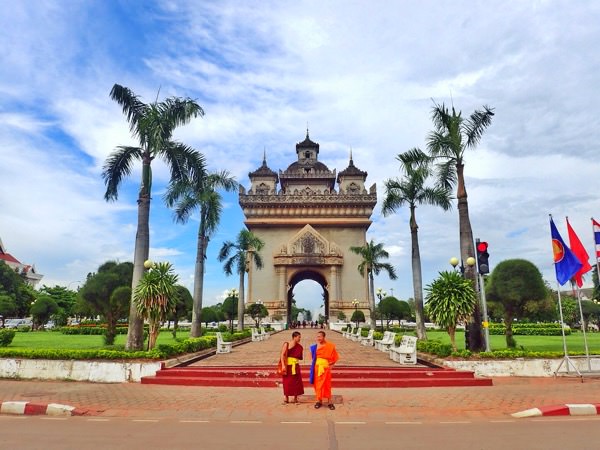
Although often referred to as Vientiane’s Arc de Triomph, the detail of its architecture is traditional Laos with many Buddhist figures and symbols on display. For a small fee, you can climb the spiral staircase up to the top of the monument for panoramic views of the formal gardens below and out across much of Vientiane.
2. Visiting Pha That Luang

From the top of Patuxai looking North East you can make out the bright, shining form of Pha That Luang in the distance. Covered in gold leaf and shaped like a pyramid, it’s widely regarded as the most important religious monument in Laos and is breathtaking in its beauty. Also referred to as the Great Golden Stupa, it has been rebuilt various times in its history having been plundered for its gold and destroyed by wars on many separate occasions.
3. Down by the River at Night
Just before dark, the area by the Mekong River turns into a bustling hub of activity. There are mass outdoor aerobics classes that take place at 6PM which you can join for under a dollar. Games of foot-volleyball take place in the sandy banks down below, and a vast night market springs up where you’ll find cheap clothes and souvenirs as well as food and drinks stalls. Many locals head down this way just to drink a beer and watch the sunset over the river which in itself is a truly unmissable experience when in Vientiane.
4. Witness Laos National Museum
Housed in an imposing colonial building, the interior of the Laos National Museum is slightly less impressive as it has definitely seen better days. That said, it’s a really interesting visit and certainly a unique blueprint for a national museum. Starting with prehistoric history and the relatively recent discovery of dinosaur bones in Laos, separate rooms run through the early history of the country before moving on to the various wars that have blighted its development in recent times. There are exhibitions of pottery, firearms and musical instruments and with Laos being one of the few countries in the world to remain under communist rule, it’s all narrated from a particularly partisan viewpoint which adds to the interest.
5. The Cope Visitor Center
Laos was severely affected by the Vietnam War and it’s estimated that there are up to 80 million un-exploded bombs that still remain strewn across the Laotian countryside today. As a result, around 50 people are injured or maimed by these bombs every year.
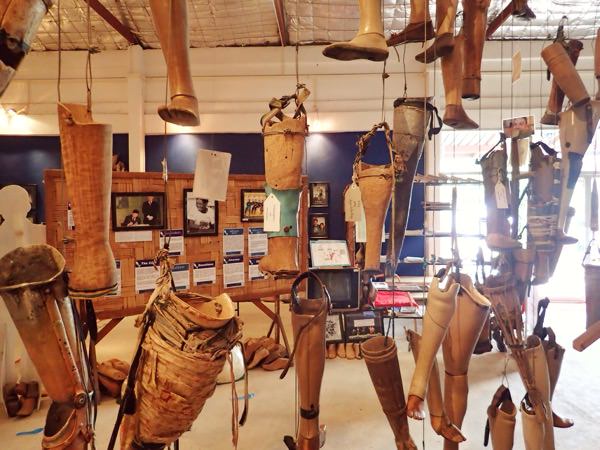
Cope is an incredible organization that provides help to those affected by these bombs, as well as by diseases such as Polio and Leprosy, by making prosthetic limbs and providing rehabilitation services. They have a brilliant visitor center in Vientiane which showcases their work and provides an insight in to the problems faced by thousands of people throughout the country. 6. Meditating with Monks
Wat Sok Pa Luang is a large temple located slightly outside of the center of Vientiane which offers the opportunity to try meditation with the young monks based here. It takes place every Saturday at 3 p.m. and is usually attended by about 10 monks and up to 20 visitors.

Many young monks use this as an opportunity to brush up on their English-speaking skills, and prior to the meditation is an hour of conversation with the monks where you’re able to learn more about their religion and culture. The meditation also lasts an hour and you’re instructed in sitting meditation and walking meditation techniques before an open Q&A where you can ask any remaining questions you may have.
7. Traditional Herbal Sauna and Massage
Just next door to Wat Sok Pa Luang is a traditional herbal sauna and massage center. It used to be located within the temple grounds but has now moved to the small woods that surround the Wat and offers a wood fired sauna as well as traditional massage available by the hour.
It’s a bit of a local secret with many Vientiane residents attending on a weekly basis so it can get quite crowded at peak times but it’s a friendly atmosphere and there’s an outdoor common space where you can chat and drink tea with new friends. If you’re able to set aside some time to spend in Vientiane, then it’s well worth staying for longer than the day that most visitors choose to spend. Elements of its culture are not found anywhere else in Laos, so before heading off to more rural areas in the Center and the North, make sure you explore the unique charms of the capital.
~Info courtesy of Travel Pulse~
Situated on the banks of the Mekong river, Vientiane the capital of Laos is often overlooked by visitors in favor of more popular destinations such as Luang Prabang for outdoor activities, Luang Namtha for trekking or Vang Vieng to go tubing. Many people dismiss it as being boring and simply use Vientiane as a gateway to Laos when crossing the Friendship bridge from Nong Khai in Thailand. But actually Vientiane is a fascinating and unique melting pot of traditional Laos culture mixed with remnants of its time spent under French colonial rule.
Roads modeled on Parisian Rues and Boulevards are lined with street sellers peddling filled baguettes, as monks pass by dressed in brightly colored orange robes on their way to temple. European looking buildings house restaurants offering traditional Laotian dishes and games of petanque played by men old enough to recall French rule take place in the shadow of tropical palm trees. Here are 7 things not to miss in Vientiane:
1. Climbing up Patuxai
Positioned at the end of Lang Xang Avenue which is reminiscent of the Champs Elysees Paris, stands Patuxai Victory Monument. It’s an impressive looking archway that was built to commemorate those soldiers killed during World War II and during the war of independence from France in 1949.
Although often referred to as Vientiane’s Arc de Triomph, the detail of its architecture is traditional Laos with many Buddhist figures and symbols on display. For a small fee, you can climb the spiral staircase up to the top of the monument for panoramic views of the formal gardens below and out across much of Vientiane.
2. Visiting Pha That Luang

From the top of Patuxai looking North East you can make out the bright, shining form of Pha That Luang in the distance. Covered in gold leaf and shaped like a pyramid, it’s widely regarded as the most important religious monument in Laos and is breathtaking in its beauty. Also referred to as the Great Golden Stupa, it has been rebuilt various times in its history having been plundered for its gold and destroyed by wars on many separate occasions.
3. Down by the River at Night
Just before dark, the area by the Mekong River turns into a bustling hub of activity. There are mass outdoor aerobics classes that take place at 6PM which you can join for under a dollar. Games of foot-volleyball take place in the sandy banks down below, and a vast night market springs up where you’ll find cheap clothes and souvenirs as well as food and drinks stalls. Many locals head down this way just to drink a beer and watch the sunset over the river which in itself is a truly unmissable experience when in Vientiane.
4. Witness Laos National Museum
Housed in an imposing colonial building, the interior of the Laos National Museum is slightly less impressive as it has definitely seen better days. That said, it’s a really interesting visit and certainly a unique blueprint for a national museum. Starting with prehistoric history and the relatively recent discovery of dinosaur bones in Laos, separate rooms run through the early history of the country before moving on to the various wars that have blighted its development in recent times. There are exhibitions of pottery, firearms and musical instruments and with Laos being one of the few countries in the world to remain under communist rule, it’s all narrated from a particularly partisan viewpoint which adds to the interest.
5. The Cope Visitor Center
Laos was severely affected by the Vietnam War and it’s estimated that there are up to 80 million un-exploded bombs that still remain strewn across the Laotian countryside today. As a result, around 50 people are injured or maimed by these bombs every year.
Cope is an incredible organization that provides help to those affected by these bombs, as well as by diseases such as Polio and Leprosy, by making prosthetic limbs and providing rehabilitation services. They have a brilliant visitor center in Vientiane which showcases their work and provides an insight in to the problems faced by thousands of people throughout the country. 6. Meditating with Monks
Wat Sok Pa Luang is a large temple located slightly outside of the center of Vientiane which offers the opportunity to try meditation with the young monks based here. It takes place every Saturday at 3 p.m. and is usually attended by about 10 monks and up to 20 visitors.
Many young monks use this as an opportunity to brush up on their English-speaking skills, and prior to the meditation is an hour of conversation with the monks where you’re able to learn more about their religion and culture. The meditation also lasts an hour and you’re instructed in sitting meditation and walking meditation techniques before an open Q&A where you can ask any remaining questions you may have.
7. Traditional Herbal Sauna and Massage
Just next door to Wat Sok Pa Luang is a traditional herbal sauna and massage center. It used to be located within the temple grounds but has now moved to the small woods that surround the Wat and offers a wood fired sauna as well as traditional massage available by the hour.
It’s a bit of a local secret with many Vientiane residents attending on a weekly basis so it can get quite crowded at peak times but it’s a friendly atmosphere and there’s an outdoor common space where you can chat and drink tea with new friends. If you’re able to set aside some time to spend in Vientiane, then it’s well worth staying for longer than the day that most visitors choose to spend. Elements of its culture are not found anywhere else in Laos, so before heading off to more rural areas in the Center and the North, make sure you explore the unique charms of the capital.
~Info courtesy of Travel Pulse~
2016年8月29日星期一
A slow boat to China
A slow boat to China

Asian cruise operator Pandaw is all set to launch the RV Laos Pandaw, a 10-cabin cruiser, on the Mekong River.
Asian cruise operator Pandaw is all set to launch the RV Laos Pandaw, a 10-cabin cruiser, on the Mekong River.
Offering cruises on the upper and lower Mekong, the first trip through Laos, Thailand and Myanmar is sold out but bookings for its maiden excursion on the upper Mekong into China are now open.
The expedition cover seven nights, beginning in Chiang Saen in Thailand's North.
The journey continues and stops over along the border of Myanmar and Laos on its way to Jinhong in Yunnan Province.
The Old Mandalay Road in Shan State, the Xiang Kok Akha Village in Laos and a tea plantation and botanical gardens are also on the itinerary. Visit www.Pandaw.com.
~News courtesy of The Nation~
Asian cruise operator Pandaw is all set to launch the RV Laos Pandaw, a 10-cabin cruiser, on the Mekong River.
Asian cruise operator Pandaw is all set to launch the RV Laos Pandaw, a 10-cabin cruiser, on the Mekong River.
Offering cruises on the upper and lower Mekong, the first trip through Laos, Thailand and Myanmar is sold out but bookings for its maiden excursion on the upper Mekong into China are now open.
The expedition cover seven nights, beginning in Chiang Saen in Thailand's North.
The journey continues and stops over along the border of Myanmar and Laos on its way to Jinhong in Yunnan Province.
The Old Mandalay Road in Shan State, the Xiang Kok Akha Village in Laos and a tea plantation and botanical gardens are also on the itinerary. Visit www.Pandaw.com.
~News courtesy of The Nation~
2016年4月9日星期六
Sand sculptures help mark Pi Mai Lao
Sand sculptures help mark Pi Mai Lao
Sand sculptures on Don Chan Beach near the Mekong River in Vientiane are nearing completion for annual Pi Mai Lao celebrations from April 13-16 with authorities expecting large crowds.

An elephant sand sculpture taking shape for Pi Mai Lao celebrations.
Contractor MsRatsadapornBusadee told Vientiane Times on Tuesday that the sand sculpting project commenced on March 8 and will be completed by this Sunday.
This year's theme is the AEC and Laos chairing Asean with artists from Laos and Thailand working together to create the sand sculptures on the Mekong River beach.
“This time there will be 15 sand sculptures focusing on the symbols of the 10 countries in Asean, especially the symbols of Laos such as the elephant and That Luangstupa,” MsRatsadaporn said.
“Last year almost 100,000 visitors saw the sand sculptures on Don Chan Beach and this time we expect even more visitors than last year,” she said.
Admission to the sand sculpture area is 10,000 kip per person with children aged under five free of charge.
During Pi Mai Lao celebrations the riverside area will host many activities such as beach football and volleyball, boxing, traditional fashion shows, concerts and stalls selling an enticing array of goods.
According to the Vientiane authority, there would be a special water pouring ceremony for older people and visitors in the area of Vat Chan up to the beach alongside Khounta village in Sikhottabong district.
This year marks the 450th anniversary of the building of Vat That Luang, which would be reflected in the festivities.
However, people from other provinces around the country will also be enjoying Pi Mai Lao, especially traditional activities such as pouring water over Buddha images.
~News courtesy of Vientiane Times~
Sand sculptures on Don Chan Beach near the Mekong River in Vientiane are nearing completion for annual Pi Mai Lao celebrations from April 13-16 with authorities expecting large crowds.
An elephant sand sculpture taking shape for Pi Mai Lao celebrations.
Contractor MsRatsadapornBusadee told Vientiane Times on Tuesday that the sand sculpting project commenced on March 8 and will be completed by this Sunday.
This year's theme is the AEC and Laos chairing Asean with artists from Laos and Thailand working together to create the sand sculptures on the Mekong River beach.
“This time there will be 15 sand sculptures focusing on the symbols of the 10 countries in Asean, especially the symbols of Laos such as the elephant and That Luangstupa,” MsRatsadaporn said.
“Last year almost 100,000 visitors saw the sand sculptures on Don Chan Beach and this time we expect even more visitors than last year,” she said.
Admission to the sand sculpture area is 10,000 kip per person with children aged under five free of charge.
During Pi Mai Lao celebrations the riverside area will host many activities such as beach football and volleyball, boxing, traditional fashion shows, concerts and stalls selling an enticing array of goods.
According to the Vientiane authority, there would be a special water pouring ceremony for older people and visitors in the area of Vat Chan up to the beach alongside Khounta village in Sikhottabong district.
This year marks the 450th anniversary of the building of Vat That Luang, which would be reflected in the festivities.
However, people from other provinces around the country will also be enjoying Pi Mai Lao, especially traditional activities such as pouring water over Buddha images.
~News courtesy of Vientiane Times~
2013年10月20日星期日
Recovery operation underway at Lao Airlines crash site
Recovery operation underway at Lao Airlines crash site
Divers from Thailand have attempted to retrieve bodies of the passengers on the Lao Airlines flight that crashed into Mekong River and killed all 49 on aboard in Laos' Champassak province on Wednesday, the Vientiane Times reported Thursday.
As of Thursday, seven bodies had already been recovered. They are being kept at Vat Chin temple in Pakse district.
Lao Airlines officials told the Times that an investigation into the cause of the accident was currently underway, with preliminary findings expected to be announced soon.
The officials spoke at a press briefing on Thursday during which they confirmed that there were no survivors from the crash, which saw the aircraft breaking up on impact.
Initial reports suggested that the plane from Vientiane encountered a heavy gust of wind as it approached the Pakse International Airport for landing.
Among the passengers killed were five Thai nationals, three of them staff member of PTT plc.
The airline's officials said they will provide all necessary assistance to the friends and relatives of those killed and keep them informed of developments.
They confirmed that the doomed Flight 301 departed Vientiane for Pakse at 2.45pm yesterday, and crashed just over an hour later while approaching Pakse airport for landing. The flight went down into the Mekong near Phaling village in Phonthong district, Champassak province.
According to the flight manifest, there was a total of 49 people onboard, all of whom are thought to have perished in the crash.
On board were two pilots, two flight attendants, one engineer and 44 passengers. There were numerous foreign nationals from some 10 countries on the flight.
The manifest listed those on board as 16 Lao nationals, seven French, six Australians, five Thai, three South Koreans, two Vietnamese, as well as an American, a Canadian, a Chinese national, a Malaysian and one person from Taiwan.
~News courtesy of The Nation~
8 bodies recovered from Mekong, 14 identified
8 bodies recovered from Mekong, 14 identified

A Lao woman, left, is comforted by a Thai woman yesterday at a Chinese temple in Pakse.
Some 38 bodies of victims from the Lao Airlines crash have been retrieved from the Mekong River, which the ill-fated Flight QV301 plunged into last Wednesday.
Fourteen of the bodies have been identified, including the Cambodian captain and three crew members, six Laotian passengers, one Vietnamese, two Australians and a Chinese passenger, according to a statement by Lao Airlines vice president Saleum Tayarath released yesterday.
He said a special team from the airline was working with national and local authorities as well as investigators from the plane manufacturer in France and rescue workers from Thailand.
It remained unclear yesterday whether any of the five Thai passengers of the turbo-prop ATR-72 plane was among the bodies found.
The plane crash occurred near Pakse airport in the southern Laotian province of Champasak.
According to an updated passenger list from the airline, there were 16 Laotians, seven French travellers, six Australians, five Thais, three South Koreans, three Vietnamese, and one national each from the United States, Malaysia, China and Taiwan.
Laotian Prime Minister Thongsing Thammavong thanked Thailand yesterday for helping with the search efforts when he met his Thai counterpart Yingluck Shinawatra in Nong Khai. Yingluck also promised "full support" to the ongoing mission to recover bodies of the crash victims and salvage the aircraft. Thai officials would also help Laos in identifying the bodies.
Yingluck said she expressed regret over the incident and that the Laotian leader thanked Thailand for its assistance.
The Thai and Lao leaders were in the northeastern province, which has a bridge connecting to the Laotian capital Vientiane, for a merit-making ceremony at Wat Pho Chai to mark the end of Buddhist Lent.
Jong-Pil Park, from South Korea's national forensic department, said the crash was a huge challenge for impoverished Laos, with damage to the bodies creating further hurdles in identification. "They need to analyse DNA samples, finger prints and dental [records]. They need to solve by cooperating with many countries," he said, adding that it could take up to two weeks to finish conducting the autopsies.
In an updated statement late yesterday, Lao Airlines said some of the bodies had been returned to their families, including the Cambodian pilot, whose body was flown back to Phnom Penh. Teams of French and Thai experts plied the muddy Mekong River with high-tech sonar equipment yesterday, ramping up the search for the remnants of the plane and more than a dozen bodies still missing from the crash.
By yesterday afternoon, 38 bodies have been found and authorities were still trying to identify many of them, said Yakua Lopangkao, director-general of Laos' Department of Civil Aviation.
"We have not been able to locate the plane yet, but the teams from France and Thailand have arrived," Yakua said.
"We have split them into several teams to do simultaneous searches at two or three spots. We believe that one of these spots is where we will find the black box."
A Canadian engineer who specialises in underwater robotics said the strong current in the Mekong could make it almost impossible to lift the plane off the bottom of the river and recover any bodies still inside the wreck. The engineer, who preferred not be named, said the strong current meant as many as six barges and cranes might be needed to lift the plane, if it could be found, and they may need to build a wall at the top end to deflect the fast moving current around the wreck.
The French and Thai teams set out on small boats yesterday to scan the water's surface with sonar equipment. Thai navy divers conducted underwater searches for the flight data and voice recorders.
~News courtesy of The Nation~
2013年7月8日星期一
泰寮第4友谊大桥 延后135天启用
泰寮第4友谊大桥 延后135天启用
清莱府泰寮第4座跨湄公河友谊大桥未能按期建成启用,将推迟正式启用135天,直到年底也能通车,但目前已能促进该地区两国边境贸易。清莱府高层官员指出,未能按期完工是技术上的原因。
原订6月10日建成启用的清莱府泰寮第4座跨湄公河友谊大桥,由于施工进度迟缓,正式启用日期一拖再拖。该大标作为连接昆曼公路R3a路线的重要路段,据清莱府资深次长他瓦猜昨天(28日)透露,该大标启用日期已确定延后135天,即最快能在今年11- 12月期间正式通车。至于造成工期延迟的原因,主要是寮国方与该大桥相连接的两座铁桥目前完成80%的施工进度,而且受到水灾影响,导致已完成98%工作量的主大桥无法按期通车。
他瓦猜指出,泰寮两国内阁决议,该大桥必须是在全部建成的状态下正式启用,使昆曼公路实现泰寮边境路段的顺畅连接。目前有两国在该大桥处的边境贸易往来,主要依靠桥下的渡轮。也有少量居民从大桥上步行过境。
据悉,这座泰寮第4座跨湄公河友谊大桥共计投资14亿8650万铢进行建设,泰寮政府各出一半资金,并由中国铁路第5工程公司与泰国KRUNGTON工程公司联合建设,从2010年6月11日开始施工,原订去年12月10日建成启用,但因各方预算未到位等原因,工期出现拖延。这座大桥跨越湄公河部分长约480米,有4座桥墩插入湄公河中,桥上路面宽14.7米,分为两个车道。
清莱府清孔县海关官员颂拉猜指出,清孔县去年的泰寮边境口岸双边贸易额为120亿铢,今年头9个月双边贸易额已突破100亿铢,预计全年可望达到140亿铢。而泰寮第4座跨湄公河友谊大桥泰方的边贸口岸和海关办事处目前也尚未建成。
~以上新闻转载自世界日报~
2013年2月21日星期四
Laos, Myanmar begin bridge
Laos, Myanmar begin bridge
Laos and Myanmar have begun the construction of the first bridge to link their countries, and expect to complete it in 2015.
The building of the Laos-Myanmar Friendship Bridge over the Mekong River between Laos' Luang Namtha province and Shan state in Myanmar was launched after the two countries held a ground-breaking ceremony on Saturday, The Vientiane Times reported on Monday.
The construction cost is US$18 million (540 million baht) and the two governments aim to use it to boost trade and investment, and enhance cooperation.
Luang Namtha governor Phimmasone Leuangkhamma, Lao Public Works and Transport Minister Sommad Pholsena and Myanmar's Construction Minister Kyaw Lwin presided over the ceremony.
The bridge will be 690 metres long and 10 metres wide and will have two vehicle lanes and two sidewalks. Construction of the bridge will take 30 months to complete.
Xaysongkham Manotham, director of the Laos-Myanmar Friendship Bridge Project, said the bridge will be a new symbol of cooperation, relations and solidarity between the two countries.
~News courtesy of Bangkok Post~
2013年2月19日星期二


订阅:
博文 (Atom)