2024年3月25日星期一

2019年11月21日星期四
World Heritage Certificate for Plain of Jars
Laos Receives World Heritage Certificate for Plain of Jars
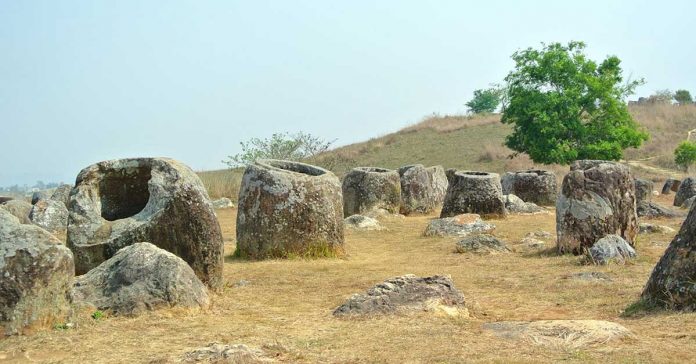
The UNESCO World Heritage Committee presented Laos with a certificate recognizing the World Heritage List designation of the Plain of Jars on Monday.
The Plain of Jars, situated on a plateau in Xieng Khuang Province, is named for the more than 2,100 tubular megalithic stone jars that are thought to have been used in the Iron Age for funeral practices.
Prof. Dr. Bosengkham Vongdara, with a special envoy of the Lao government, was presented with the award at the Forum of Ministers of Culture during the 40th session of the UNESCO General Conference held at the headquarters of UNESCO in Paris, France.
“We highly appreciate the role of UNESCO in fostering cultural diversity so that we can conserve and develop our own diverse and unique national culture and learn closely and constructively from each other,” said Prof. Dr. Bonsengkham Vondara when speaking at the certificate ceremony.
“In addition, our government is making a great effort to our heritage through tourism. By maintaining and opening up our cultural and historical sites, our aim is to grow and encourage cultural tourism, natural eco-tourism, and historical tourism.”

The Plain of Jars, formally called the Megalithic Jar Sites, was officially inscribed on the World Heritage List at a World Heritage Committee meeting held in Baku, Azerbaijan on July 10 this year, after submission in 2018.

Prof. Dr. Bosengkham Vongdara receives the Plain of Jars World Heritage Certificate in Paris, France.
The Plain of Jars is the third World Heritage Site in Laos. Luang Prabang, the former capital of Laos’s Lanexang Kingdom, was declared a World Heritage City in 1995, followed in 2001 by the site of Vat Phou in Champasack.
Xieng Khuang is situated 435 km north of Vientiane and is accessible by road or by air.
~Laotian Times~
The UNESCO World Heritage Committee presented Laos with a certificate recognizing the World Heritage List designation of the Plain of Jars on Monday.
The Plain of Jars, situated on a plateau in Xieng Khuang Province, is named for the more than 2,100 tubular megalithic stone jars that are thought to have been used in the Iron Age for funeral practices.
Prof. Dr. Bosengkham Vongdara, with a special envoy of the Lao government, was presented with the award at the Forum of Ministers of Culture during the 40th session of the UNESCO General Conference held at the headquarters of UNESCO in Paris, France.
“We highly appreciate the role of UNESCO in fostering cultural diversity so that we can conserve and develop our own diverse and unique national culture and learn closely and constructively from each other,” said Prof. Dr. Bonsengkham Vondara when speaking at the certificate ceremony.
“In addition, our government is making a great effort to our heritage through tourism. By maintaining and opening up our cultural and historical sites, our aim is to grow and encourage cultural tourism, natural eco-tourism, and historical tourism.”
The Plain of Jars, formally called the Megalithic Jar Sites, was officially inscribed on the World Heritage List at a World Heritage Committee meeting held in Baku, Azerbaijan on July 10 this year, after submission in 2018.
Prof. Dr. Bosengkham Vongdara receives the Plain of Jars World Heritage Certificate in Paris, France.
The Plain of Jars is the third World Heritage Site in Laos. Luang Prabang, the former capital of Laos’s Lanexang Kingdom, was declared a World Heritage City in 1995, followed in 2001 by the site of Vat Phou in Champasack.
Xieng Khuang is situated 435 km north of Vientiane and is accessible by road or by air.
~Laotian Times~
2017年3月23日星期四
Plain Of Jars: Unique Places Around The World
Plain Of Jars: Unique Places Around The World
Plain of Jars is a large archaeological landscape found in Laos.

The Plain of Jars site.
The Plain of Jars is perhaps one of the most prolific sites in Laos. From overall aesthetics to the essential details, the plain symbolizes an oasis of ancient artifacts amid threats of a diminishing history around the region. Apart from being an established sanctuary, the Plain of Jars contributes majorly towards the economy. Although this nature reserve stands out as a major positive contributor towards the livelihood, it most certainly faces significant threats which may require future consideration.
5. Description

The Plain of Jars is located far in the northern regions of Annamese Cordillera, which is one of the largest mountain range in Southeast Asia. The archaeological landscape consists of various stones shaped in the form of jars. These beautiful jars are carefully arranged in a cluster-like manner. The distribution of the jars spans both the valley as well as the foothills in the mid-plain of Laos. It was not until 1930 that Madeleine Colani, a famous French researcher established that the jars came as a result of ancient burial practices. Excavation projects since then have confirmed this.
4. Tourism
Like many prehistoric sites, the Plain of Jars attracts many tourists from around the globe every year. This translates to a significant economic value regarding foreign exchange and other aspects such as international relationships. The breathtaking landscape acts as a distinct region where tourists come to quench their thirst for new experiences. The government has equally invested in the region by ensuring a safe and a convenient passage to the tourist site. There is a bus and air travel to the regions surrounding the plains. Although tourism in the region is still being fostered due to the bombings which occurred between 1964 to 1973, there are profound measures which have been put to restore the pride of the Plain of Jars.
3. Uniqueness
Even though there is substantial evidence to ascertain the origin of the jars in the region, the jars continue to carry an air of mystery. There is no clear fact that shows the maker of the jars and their reason. The bizarre collection of scattered jars in the plain is one of the unique sites one’s eyes meet upon visiting the plain. The presence of five different types of stones within the wall structure of the jars is also a startling occurrence that further serves to explore the uniqueness of the jars.
2. Habitat
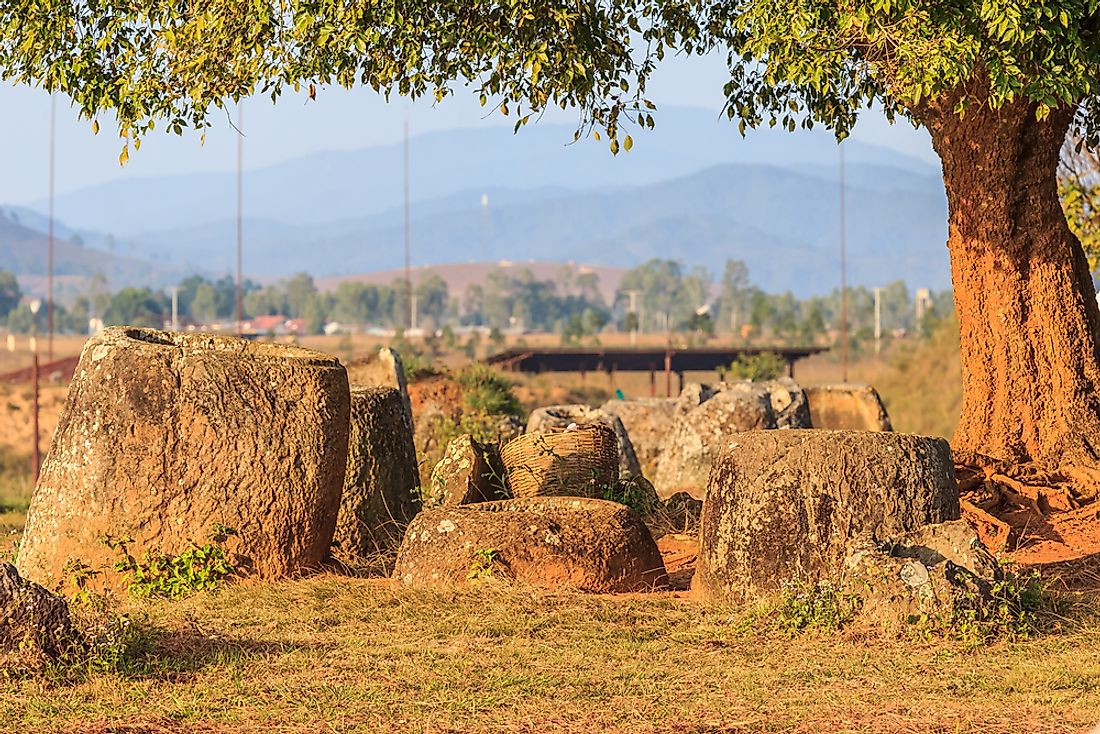
The jars are mostly located in a plain which mostly has grass and scattered trees growing around them. Although the most attractive features about the plain are the jars, wildlife is also an occasional occurrence as small animals can be seen on the plains.
1. Threats

Between the years of 1964 to 1973, the U.S. Air Force bombed the Plain of Jars heavily in an effort against the communist forces of Pathet Lao and North Vietnam. A staggering amount of these bombs never exploded, and remain an active deadly threat in the area. As such, sightseeing can only be done on paths which have been clearly indicated. A program titled "Safeguarding the Plain of Jars" is a joint effort between Laos and the United Nations, with the intention to make the Plain of Jars safe enough to be a UNESCO Heritage Site.
~News courtesy of World Atlas~
Plain of Jars is a large archaeological landscape found in Laos.
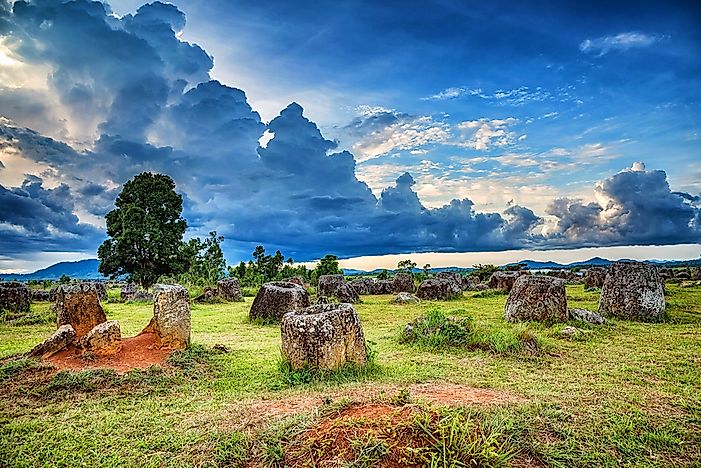
The Plain of Jars site.
The Plain of Jars is perhaps one of the most prolific sites in Laos. From overall aesthetics to the essential details, the plain symbolizes an oasis of ancient artifacts amid threats of a diminishing history around the region. Apart from being an established sanctuary, the Plain of Jars contributes majorly towards the economy. Although this nature reserve stands out as a major positive contributor towards the livelihood, it most certainly faces significant threats which may require future consideration.
5. Description
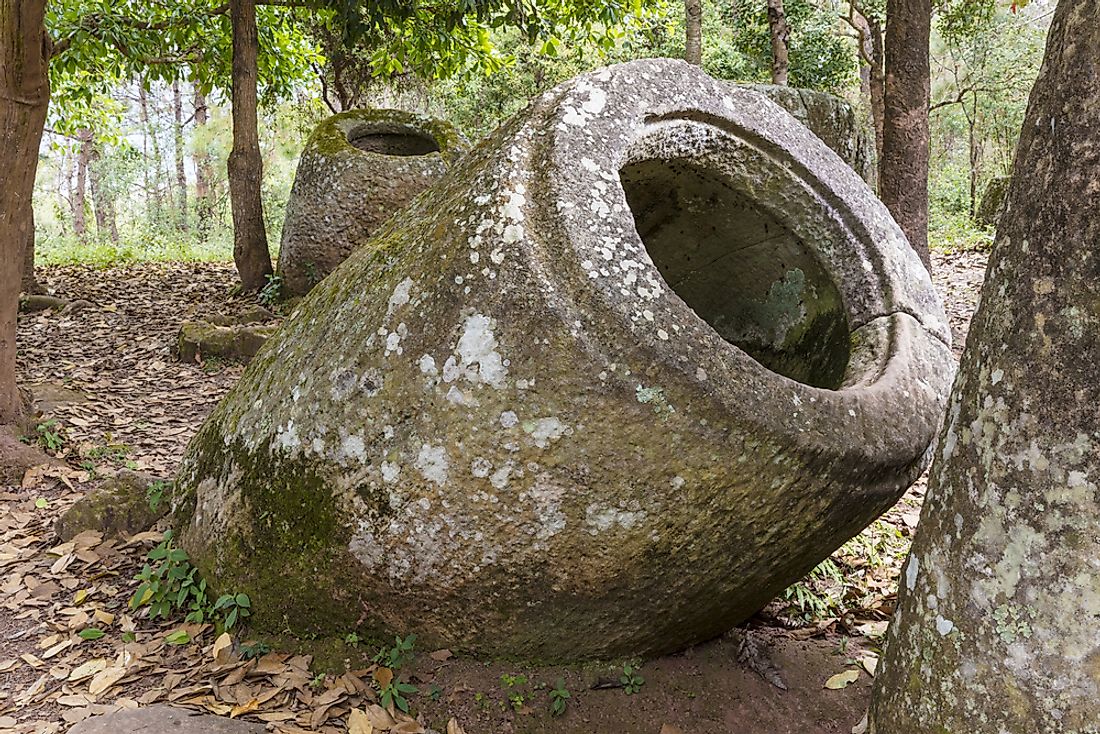
The Plain of Jars is located far in the northern regions of Annamese Cordillera, which is one of the largest mountain range in Southeast Asia. The archaeological landscape consists of various stones shaped in the form of jars. These beautiful jars are carefully arranged in a cluster-like manner. The distribution of the jars spans both the valley as well as the foothills in the mid-plain of Laos. It was not until 1930 that Madeleine Colani, a famous French researcher established that the jars came as a result of ancient burial practices. Excavation projects since then have confirmed this.
4. Tourism
Like many prehistoric sites, the Plain of Jars attracts many tourists from around the globe every year. This translates to a significant economic value regarding foreign exchange and other aspects such as international relationships. The breathtaking landscape acts as a distinct region where tourists come to quench their thirst for new experiences. The government has equally invested in the region by ensuring a safe and a convenient passage to the tourist site. There is a bus and air travel to the regions surrounding the plains. Although tourism in the region is still being fostered due to the bombings which occurred between 1964 to 1973, there are profound measures which have been put to restore the pride of the Plain of Jars.
3. Uniqueness
Even though there is substantial evidence to ascertain the origin of the jars in the region, the jars continue to carry an air of mystery. There is no clear fact that shows the maker of the jars and their reason. The bizarre collection of scattered jars in the plain is one of the unique sites one’s eyes meet upon visiting the plain. The presence of five different types of stones within the wall structure of the jars is also a startling occurrence that further serves to explore the uniqueness of the jars.
2. Habitat
The jars are mostly located in a plain which mostly has grass and scattered trees growing around them. Although the most attractive features about the plain are the jars, wildlife is also an occasional occurrence as small animals can be seen on the plains.
1. Threats
Between the years of 1964 to 1973, the U.S. Air Force bombed the Plain of Jars heavily in an effort against the communist forces of Pathet Lao and North Vietnam. A staggering amount of these bombs never exploded, and remain an active deadly threat in the area. As such, sightseeing can only be done on paths which have been clearly indicated. A program titled "Safeguarding the Plain of Jars" is a joint effort between Laos and the United Nations, with the intention to make the Plain of Jars safe enough to be a UNESCO Heritage Site.
~News courtesy of World Atlas~
2014年10月20日星期一
Wildlife experience of a lifetime
Wildlife experience of a lifetime
Moments before visitors go down for a good night's sleep in the northern province after an adventurous day of wildlife sightings, the experienced tour-guide tells them, “No need to set your alarms, the birds will chirp and you wake up pleasantly.”

A skilled boatman calmly navigates his vessel in the strong currents.
Relaxed and at ease, the guests head to bed before the heavy rainfall sets in. I momentarily think to myself, ‘there is no way I will hear the birds chirping in this thunderstorm', but the rain has already eased me into a deep and peaceful sleep.
In a dazed state, a sound catches in my ear. A slight buzzing can be heard in my mosquito net. However, it does not bother me as I drift in and out of sleep.
The sound intensifies and jolts me awake. My eyes still blurry, I see a small flying object dart around as I try to shake my sleep off and rub my eyes.
Clawing out of my net, I couldn't believe my eyes. My friend's boot moves in a slow motion. Frightened and in disbelief, I discovered a kaleidoscope of butterflies trapped inside. This was one of my most memorable experiences at the eco-lodge in Nam Et-Phou Louey National Protected Area (NEPL NPA), located along the Nam Nern River in Huaphan province.
The trip is an adventure of exploring wildlife, insects and unique plants, with the Night Safari being a highlight of the experience. The safari was open to the public in 2010 and has been booming ever since.
The untouched nature in this protected area has allowed my friends and I to experience the environment in its most purest form.
Tracking wildlife in the rainy season is possibly the most difficult as you need to rely heavily on your tour-guide's sharp eyesight to witness the animals and insects. The experienced tour-guides running the wildlife tours and treks are experienced hunters, who have turned into rangers and conservers of the abundant forest.
The day before our stay at the eco-lodge, our tour guide took us on a journey along the river, telling us that we were lucky that the water level was not as high, which made our travel faster than usual.
I anticipated the boat trip to take around an hour, however, this was certainly not the case. Upon boarding the boat, we experienced the strongest current I have ever felt. The boat struggled upstream against the current and with one hand clasped firmly on the edge of the boat and one hand secured around my camera, we began our wildlife adventure.
The view of our luscious, green surroundings along with snakes, green lizards and monitor lizards were captivating and made you forget how turbulent the boat was.
The experienced boatmen and guides were able to spot the wildlife from a distance. Their sharp eyes caught the animals even though they were camouflaged.
One tour-guide sat on top of the boat to navigate and make sure that we were on the right track, while the skilled boatmen manoeuvred the boat upstream. I was thoroughly impressed by the skills of the guides as they delivered us to the eco-lodge in a calm and safe manner, regardless of the strong currents and turbulent journey.
Once we reached the eco-lodge, where we stayed overnight, we were given the chance to trek in the forest and see the wildlife, insects and plants close up.
We were able to witness animal tracks leading to an area known as ‘salt lick', where animals are attracted to the minerals found in the ground of the forest. The animals gather to lick the ground for its salty taste.
We desperately wanted to reach the area, even though the track was muddy and leeches were scattered along our path.
Halfway through the trek, we were afraid that we would not be able to make it as the sky was darkening and the heavy clouds were forming. We decided to try our luck and navigate our way to a closer salt lick area.
We were successful in reaching the closer salt lick location and were able to identify a type of fruit the wildlife liked to consume. The guide told us that this was called cardamom.
After our explorations, we headed back to the eco-lodge and as I laid my head down listening to the rain and reminiscing on our adventure, I drifted into the land of dreams waiting for the sound of the birds chirping in the morning.
This trip is one of the most valuable experiences for people who would like to learn about local wildlife and villages in Laos. NEPL-NPA can be reached by local bus or trucks, with the journey taking a few hours from Xieng Khouang province.
~Info courtesy of Vientiane Times~
Moments before visitors go down for a good night's sleep in the northern province after an adventurous day of wildlife sightings, the experienced tour-guide tells them, “No need to set your alarms, the birds will chirp and you wake up pleasantly.”

A skilled boatman calmly navigates his vessel in the strong currents.
Relaxed and at ease, the guests head to bed before the heavy rainfall sets in. I momentarily think to myself, ‘there is no way I will hear the birds chirping in this thunderstorm', but the rain has already eased me into a deep and peaceful sleep.
In a dazed state, a sound catches in my ear. A slight buzzing can be heard in my mosquito net. However, it does not bother me as I drift in and out of sleep.
The sound intensifies and jolts me awake. My eyes still blurry, I see a small flying object dart around as I try to shake my sleep off and rub my eyes.
Clawing out of my net, I couldn't believe my eyes. My friend's boot moves in a slow motion. Frightened and in disbelief, I discovered a kaleidoscope of butterflies trapped inside. This was one of my most memorable experiences at the eco-lodge in Nam Et-Phou Louey National Protected Area (NEPL NPA), located along the Nam Nern River in Huaphan province.
The trip is an adventure of exploring wildlife, insects and unique plants, with the Night Safari being a highlight of the experience. The safari was open to the public in 2010 and has been booming ever since.
The untouched nature in this protected area has allowed my friends and I to experience the environment in its most purest form.
Tracking wildlife in the rainy season is possibly the most difficult as you need to rely heavily on your tour-guide's sharp eyesight to witness the animals and insects. The experienced tour-guides running the wildlife tours and treks are experienced hunters, who have turned into rangers and conservers of the abundant forest.
The day before our stay at the eco-lodge, our tour guide took us on a journey along the river, telling us that we were lucky that the water level was not as high, which made our travel faster than usual.
I anticipated the boat trip to take around an hour, however, this was certainly not the case. Upon boarding the boat, we experienced the strongest current I have ever felt. The boat struggled upstream against the current and with one hand clasped firmly on the edge of the boat and one hand secured around my camera, we began our wildlife adventure.
The view of our luscious, green surroundings along with snakes, green lizards and monitor lizards were captivating and made you forget how turbulent the boat was.
The experienced boatmen and guides were able to spot the wildlife from a distance. Their sharp eyes caught the animals even though they were camouflaged.
One tour-guide sat on top of the boat to navigate and make sure that we were on the right track, while the skilled boatmen manoeuvred the boat upstream. I was thoroughly impressed by the skills of the guides as they delivered us to the eco-lodge in a calm and safe manner, regardless of the strong currents and turbulent journey.
Once we reached the eco-lodge, where we stayed overnight, we were given the chance to trek in the forest and see the wildlife, insects and plants close up.
We were able to witness animal tracks leading to an area known as ‘salt lick', where animals are attracted to the minerals found in the ground of the forest. The animals gather to lick the ground for its salty taste.
We desperately wanted to reach the area, even though the track was muddy and leeches were scattered along our path.
Halfway through the trek, we were afraid that we would not be able to make it as the sky was darkening and the heavy clouds were forming. We decided to try our luck and navigate our way to a closer salt lick area.
We were successful in reaching the closer salt lick location and were able to identify a type of fruit the wildlife liked to consume. The guide told us that this was called cardamom.
After our explorations, we headed back to the eco-lodge and as I laid my head down listening to the rain and reminiscing on our adventure, I drifted into the land of dreams waiting for the sound of the birds chirping in the morning.
This trip is one of the most valuable experiences for people who would like to learn about local wildlife and villages in Laos. NEPL-NPA can be reached by local bus or trucks, with the journey taking a few hours from Xieng Khouang province.
~Info courtesy of Vientiane Times~
订阅:
博文 (Atom)