2025年7月22日星期二

2025年4月7日星期一
2025年3月1日星期六
2024年12月16日星期一
2024年7月3日星期三
2022年12月28日星期三
4000 ISLANDS, DON KHON & DON DET 🇱🇦 I LAOS
We visited Don Khon and Don Get situated in the south of Laos! This group of islands called 4000 island (because there is 4000 of them) are in the middle of the Mekong river. To get from here from Pakse is only a short 2 hour ride and a small boat ride to the island. These islands are so relaxed and really are a backpackers utopia!
Come with us as we explore both islands on the bicycle. Did we make a mistake visiting in the wet season though ? The answer is YES! We wished we visited in the dry season as you would be able to access the beach and also see the amazing waterfalls better.
We hope you enjoy the video :)
2020年3月12日星期四
The 4000 Islands by Kayak
The 4000 Islands by Kayak

The 4000 Islands in southern Laos, low lying sandy clumps in the Mekong River, are famous for their easy-going pace, banana pancakes, afternoons in hammocks, dolphin-spotting opportunities, wide-sky sunsets, and raucous parties.
I’ve cycled over traces of the old French railway tracks through mango and teak forests, walked the slow loop of sandy trails wriggling through the islands’ small communities, and flitted about from one vestige of French power to another, to bar, to café, and guesthouse many times. I’d never considered taking to the water, though, until now.
The Mekong River can look formidable at times – a fast-flowing wide milk chocolate brown river cut with rocky islands and drowned trees. But a kayaking trip sounded exciting, and with a chance to spot the area’s rare Irrawaddy dolphins, too, I eagerly signed up.
Green Paradise’s kayaking expedition wisely includes free breakfast for its mainly land-lubber clientele. After fuelling up with baguette, egg, and thick Lao coffee at a restaurant on Don Det island, we grabbed life jackets and tucked into our kayaks. Hoping to halve the work of paddling, I jumped into a kayak with our guide, Mr. Sam.
V Patient Mr. Sam spent a good deal of time barking ‘right, right’ as our crew of 21 – Brits, Australians, Dutch, French, and Hungarians – took to the water like ducks, I mean clumsy humans, grappling with kayak balance, water flow, and huge thickets of vegetation that reared up unexpectedly.
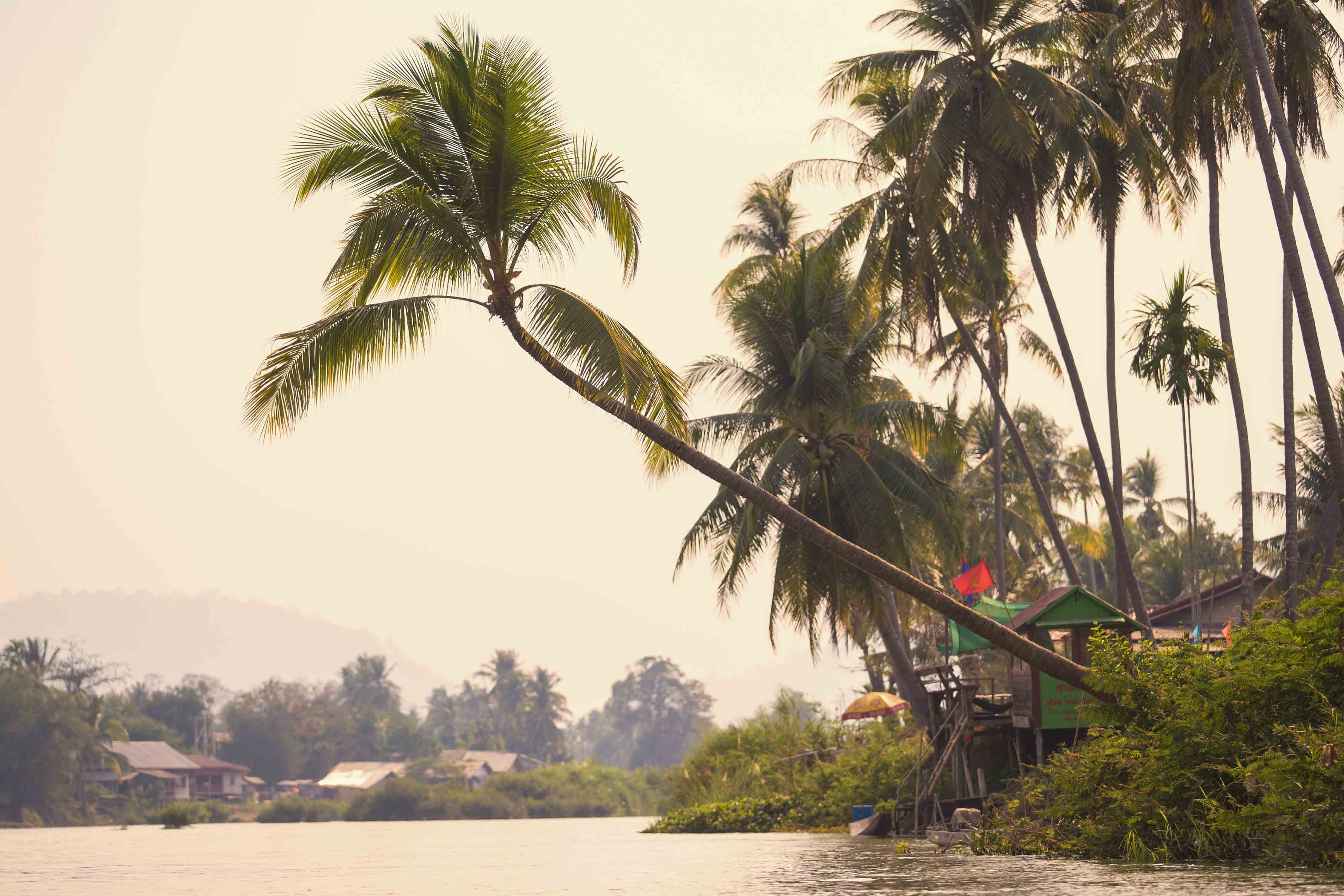
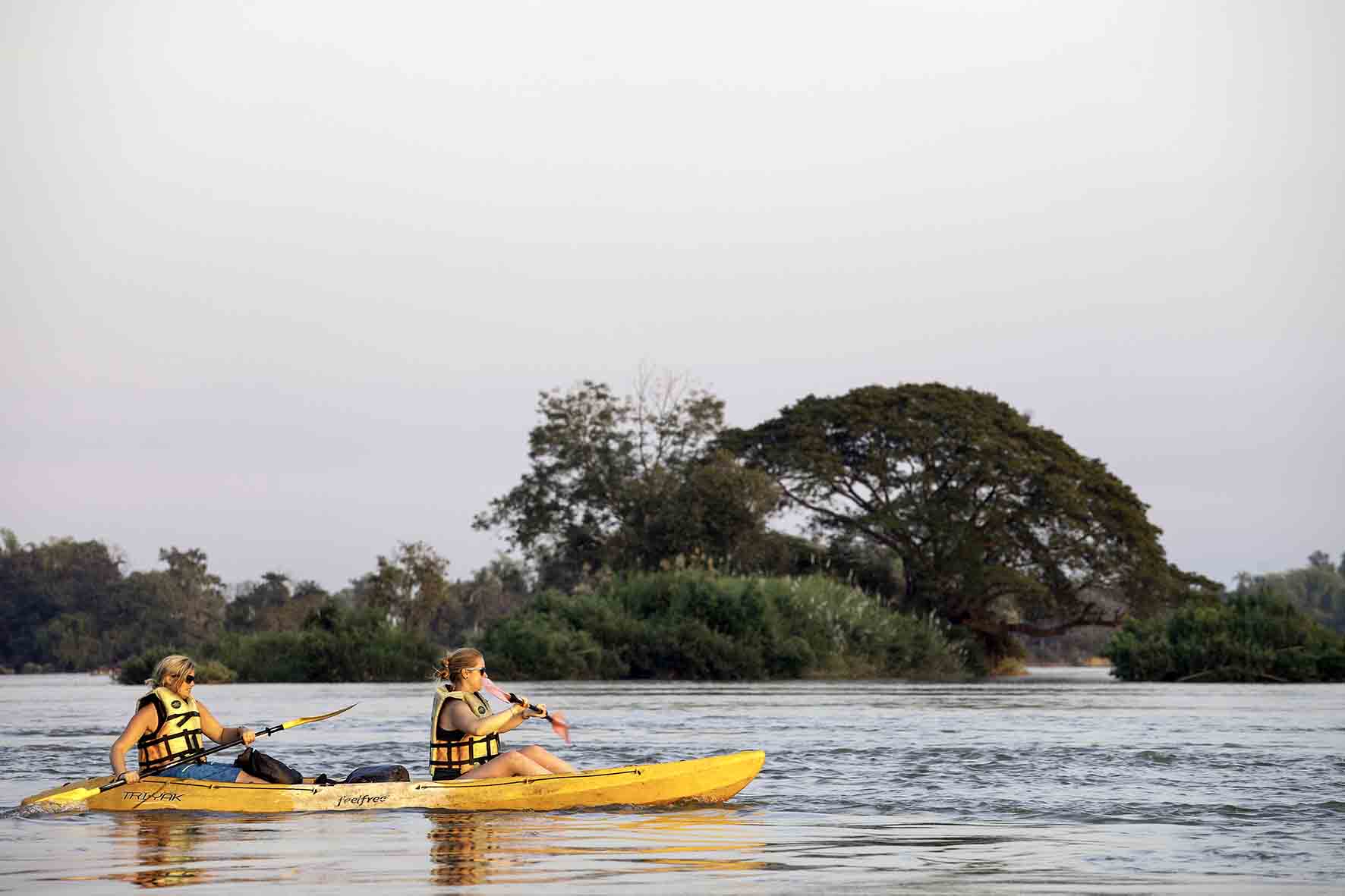
Our first destination was downstream at Don Khone Island’s Pa Soi rapids. Early on we temporarily lost part of the group, one kayak team fell into the river, and one kayak got sucked into a cluster of bushes and became entangled. The heat was unforgiving but we giggled at these mishaps and continued on our journey navigating clumps of trees and mini islands. We parked up just before Pa Soi rapids and walked over a bridge to look at the frothing water below.
The kayaks had been moved beyond Pa Soi Falls to a safe spot; we boarded them again for a journey to the bottom of Khone Island. At Hang Khone village, at the tip of Khone Island, we packed into a longtail boat to head upstream in search of the critically endangered Irrawaddy dolphin. We clambered up the sandy hill of a large island and looked across the stream of the fast-flowing river. The dolphins, their wet skin glistening in the sun, surfaced and ducked as they searched for fish in the food-rich pools. It was thrilling to catch a glimpse of these rare mammals. The WWF reports there’s been a slight increase in their numbers in the Mekong in Cambodia from 80 in 2015 to 92 in 2017 but not in Laos. In the Lao Mekong, there are just three. While munching on a lunch of baguette, chicken, and fried rice we saw all three of them about 30 to 40 times – all fins, snouts, sleek metal-grey bodies gleaming in the strong sun.
Back at Khone Island we fetched our kayaks and headed out downriver to a pickup point on the mainland at Ban Veunkham. The sun was crippling but, like a miracle, there on the riverbank at Ban Veunkham was a stall with a packed icebox. We cleaned it out of Beerlao and Coke before boarding a truck to visit the mother of all waterfalls – the kilometers-wide Khone Phapheng Falls.
At first sight, you can see why it defeated French colonial explorers. It’s a seething, frothing mass of thundering water swirling over sturdy boulders as it fights to enter Cambodia and the lower Mekong. The French found themselves in these parts when they were shoring up claims to the river and their Indochina colonies. The French needed to move gunboats into position to defend new territorial claims but navigating past the raging Khone Phapheng Falls – with its 21-meter drop – had defeated French minds. They built a railway across Khone Island, directly west of the Phapheng Falls, so two gunboats could be hauled across it; the railway infrastructure (some of which we saw at Hang Khone village) was later adapted for commercial traffic with steamboats on the river thrown into the mix. When roads were built in the 1930s the railway fell into disuse. Today, rusty locomotives stand abandoned at the edge of paddy fields, the last tangible remnants of island railway traffic.
After ice cream – more energy – we boarded our kayaks at Nakasang village to paddle downstream and back to Don Det Island. As the rose-pink sun began to set, the light was beautiful, the water appeared like silk, clumps of greenery took on a velvet glow, and fishermen were pootling about in pirogues.
Of course, after so much exercise, we replenished our muscles with more sundowner Beerlao as soon as we clambered back on to dry land!
GETTING THERE
Lao Airlines has daily flights to Pakse from Vientiane, Luang Prabang, and Bangkok. The 4000 Islands are 3 hours south of Pakse by road.
~The Laotian Times~
The 4000 Islands in southern Laos, low lying sandy clumps in the Mekong River, are famous for their easy-going pace, banana pancakes, afternoons in hammocks, dolphin-spotting opportunities, wide-sky sunsets, and raucous parties.
I’ve cycled over traces of the old French railway tracks through mango and teak forests, walked the slow loop of sandy trails wriggling through the islands’ small communities, and flitted about from one vestige of French power to another, to bar, to café, and guesthouse many times. I’d never considered taking to the water, though, until now.
The Mekong River can look formidable at times – a fast-flowing wide milk chocolate brown river cut with rocky islands and drowned trees. But a kayaking trip sounded exciting, and with a chance to spot the area’s rare Irrawaddy dolphins, too, I eagerly signed up.
Green Paradise’s kayaking expedition wisely includes free breakfast for its mainly land-lubber clientele. After fuelling up with baguette, egg, and thick Lao coffee at a restaurant on Don Det island, we grabbed life jackets and tucked into our kayaks. Hoping to halve the work of paddling, I jumped into a kayak with our guide, Mr. Sam.
V Patient Mr. Sam spent a good deal of time barking ‘right, right’ as our crew of 21 – Brits, Australians, Dutch, French, and Hungarians – took to the water like ducks, I mean clumsy humans, grappling with kayak balance, water flow, and huge thickets of vegetation that reared up unexpectedly.
Our first destination was downstream at Don Khone Island’s Pa Soi rapids. Early on we temporarily lost part of the group, one kayak team fell into the river, and one kayak got sucked into a cluster of bushes and became entangled. The heat was unforgiving but we giggled at these mishaps and continued on our journey navigating clumps of trees and mini islands. We parked up just before Pa Soi rapids and walked over a bridge to look at the frothing water below.
The kayaks had been moved beyond Pa Soi Falls to a safe spot; we boarded them again for a journey to the bottom of Khone Island. At Hang Khone village, at the tip of Khone Island, we packed into a longtail boat to head upstream in search of the critically endangered Irrawaddy dolphin. We clambered up the sandy hill of a large island and looked across the stream of the fast-flowing river. The dolphins, their wet skin glistening in the sun, surfaced and ducked as they searched for fish in the food-rich pools. It was thrilling to catch a glimpse of these rare mammals. The WWF reports there’s been a slight increase in their numbers in the Mekong in Cambodia from 80 in 2015 to 92 in 2017 but not in Laos. In the Lao Mekong, there are just three. While munching on a lunch of baguette, chicken, and fried rice we saw all three of them about 30 to 40 times – all fins, snouts, sleek metal-grey bodies gleaming in the strong sun.
Back at Khone Island we fetched our kayaks and headed out downriver to a pickup point on the mainland at Ban Veunkham. The sun was crippling but, like a miracle, there on the riverbank at Ban Veunkham was a stall with a packed icebox. We cleaned it out of Beerlao and Coke before boarding a truck to visit the mother of all waterfalls – the kilometers-wide Khone Phapheng Falls.
At first sight, you can see why it defeated French colonial explorers. It’s a seething, frothing mass of thundering water swirling over sturdy boulders as it fights to enter Cambodia and the lower Mekong. The French found themselves in these parts when they were shoring up claims to the river and their Indochina colonies. The French needed to move gunboats into position to defend new territorial claims but navigating past the raging Khone Phapheng Falls – with its 21-meter drop – had defeated French minds. They built a railway across Khone Island, directly west of the Phapheng Falls, so two gunboats could be hauled across it; the railway infrastructure (some of which we saw at Hang Khone village) was later adapted for commercial traffic with steamboats on the river thrown into the mix. When roads were built in the 1930s the railway fell into disuse. Today, rusty locomotives stand abandoned at the edge of paddy fields, the last tangible remnants of island railway traffic.
After ice cream – more energy – we boarded our kayaks at Nakasang village to paddle downstream and back to Don Det Island. As the rose-pink sun began to set, the light was beautiful, the water appeared like silk, clumps of greenery took on a velvet glow, and fishermen were pootling about in pirogues.
Of course, after so much exercise, we replenished our muscles with more sundowner Beerlao as soon as we clambered back on to dry land!
GETTING THERE
Lao Airlines has daily flights to Pakse from Vientiane, Luang Prabang, and Bangkok. The 4000 Islands are 3 hours south of Pakse by road.
~The Laotian Times~
2019年2月17日星期日
Tad Soung Waterfall - Salavanh Province
TAD SOUNG WATERFALL
SALAVANH PROVINCE

When many people think of a river’s direction, they assume it flows from north to south. However the Xe Set River originates in the Bolaven Plateau’s north and continues in the same direction to the highland’s edge before plummeting 90 meters off a totally vertical cliff at Tad Soung Waterfall.
Reaching the head of the falls is quite easy; a walk of less than 1 kilometer from Saneum Nai leads to a set of natural stairs descending to Tad Soung. French colonials built a series of ladders along a similar route, but a rockslide destroyed them decades ago.
Though much of the Xe Set’s volume is diverted into turbines to feed power to hydroelectric plants, Tad Soung remains quite spectacular, as does its dramatic yet relaxing perch. A pavilion used by locals sits near the Xe Set’s banks as the river eases down boulders into small pools before reaching a wide, flat rocky floor and Tad Soung’s precipitous edge.
~Courtesy of Laos Simply Beautiful(Facebook)~
SALAVANH PROVINCE

When many people think of a river’s direction, they assume it flows from north to south. However the Xe Set River originates in the Bolaven Plateau’s north and continues in the same direction to the highland’s edge before plummeting 90 meters off a totally vertical cliff at Tad Soung Waterfall.
Reaching the head of the falls is quite easy; a walk of less than 1 kilometer from Saneum Nai leads to a set of natural stairs descending to Tad Soung. French colonials built a series of ladders along a similar route, but a rockslide destroyed them decades ago.
Though much of the Xe Set’s volume is diverted into turbines to feed power to hydroelectric plants, Tad Soung remains quite spectacular, as does its dramatic yet relaxing perch. A pavilion used by locals sits near the Xe Set’s banks as the river eases down boulders into small pools before reaching a wide, flat rocky floor and Tad Soung’s precipitous edge.
~Courtesy of Laos Simply Beautiful(Facebook)~
2019年1月28日星期一
Khammuan’s Tha Falang creating social media buzz
Khammuan’s Tha Falang creating social media buzz among visitors

KHAMMUAN (Vientiane Times/ANN) - The new Tha Falang development in Khammuan province is receiving lots of interest from domestic and international visitors after numerous pictures of the beautiful site have been shared on social media.
Located on the Nam Don river in Thakhaek district, the site opened last month ahead of this year’s scheduled commencement.
KK Transport and Service Company was authorised by Khammuan province to develop the site, which is located between Thock-Nayor and Songkhone villages.
A Memorandum of Understanding for the project was signed between the provincial Planning and Investment Department and the company in May last year. Company CEO Mr Khambee Lattanavong told Vientiane Times yesterday that Tha Falang was officially opened on December 8 after the company completed some facilities ahead of schedule.
“The facilities are designed to attract Europeans followed by Thai visitors,” he said.
The planned development sees the construction of 20 bungalows near the riverbank and 30 further inland as well as the provision of 100 kayaks for rent. The kayaks can be paddled over a 5km section of the river with motorboats also to be provided along with restaurants, a market, and other facilities.
Mr Khambee said the company was currently operating only some of the activities including 20 picnic huts near the riverbank, rental kayaks, a restaurant, and retail outlet.
He expected to build 20 more huts, and the bungalows will be completed in the next two months.
Kayaks cost 69,000 kip per person to rent or 85,000 kip for two people and 99,000 kip for three. Tubing rental is 20,000 kip and 50,000 kip for hut rental, while entrance and toilets are free of charge.
Tha Falang is currently attracting 100-150 visitors each weekday peaking at 300 on Saturdays and Sundays. Prior to the development, the site attracted only 50-60 people a day for swimming. Most of the visitors so far are Lao and Thai.
Tha Falang is 10 km from the centre of Thakhaek district. Khammuan is located in central Laos and borders Borikhamxay and Savannakhet provinces. Travel by private vehicle to the province takes 4-5 hours from Vientiane.

KHAMMUAN (Vientiane Times/ANN) - The new Tha Falang development in Khammuan province is receiving lots of interest from domestic and international visitors after numerous pictures of the beautiful site have been shared on social media.
Located on the Nam Don river in Thakhaek district, the site opened last month ahead of this year’s scheduled commencement.
KK Transport and Service Company was authorised by Khammuan province to develop the site, which is located between Thock-Nayor and Songkhone villages.
A Memorandum of Understanding for the project was signed between the provincial Planning and Investment Department and the company in May last year. Company CEO Mr Khambee Lattanavong told Vientiane Times yesterday that Tha Falang was officially opened on December 8 after the company completed some facilities ahead of schedule.
“The facilities are designed to attract Europeans followed by Thai visitors,” he said.
The planned development sees the construction of 20 bungalows near the riverbank and 30 further inland as well as the provision of 100 kayaks for rent. The kayaks can be paddled over a 5km section of the river with motorboats also to be provided along with restaurants, a market, and other facilities.
Mr Khambee said the company was currently operating only some of the activities including 20 picnic huts near the riverbank, rental kayaks, a restaurant, and retail outlet.
He expected to build 20 more huts, and the bungalows will be completed in the next two months.
Kayaks cost 69,000 kip per person to rent or 85,000 kip for two people and 99,000 kip for three. Tubing rental is 20,000 kip and 50,000 kip for hut rental, while entrance and toilets are free of charge.
Tha Falang is currently attracting 100-150 visitors each weekday peaking at 300 on Saturdays and Sundays. Prior to the development, the site attracted only 50-60 people a day for swimming. Most of the visitors so far are Lao and Thai.
Tha Falang is 10 km from the centre of Thakhaek district. Khammuan is located in central Laos and borders Borikhamxay and Savannakhet provinces. Travel by private vehicle to the province takes 4-5 hours from Vientiane.
2017年9月19日星期二
Top 5 things to do in Luang Prabang, Laos
Top 5 things to do in Luang Prabang, Laos
In between Vietnam and Thailand, Laos is lesser-known and lesser-discovered, but no less interesting than its pair of famous neighbours.
As a long thin country that also touches China to the north and Cambodia to the south, the landscape varies wildly; from thickly-forested areas to more tropical surrounds with plunging waterfalls and thousands of islands.

No trip to this country would be complete without a couple of days in former royal capital, Luang Prabang, so beautifully preserved that it became a UNESCO World Heritage Site in 1995.
Make sure you’re camera-ready as you take it all in; there’s a photo opportunity around every magical corner. Gilded temples with sloping roofs gleam in the sunshine, faded French colonial villas line the streets, and the rolling mountains and the Mekong and Nam Khan rivers lay just beyond the town.
Everything ticks over at a leisurely pace, substituting the frenetic energy of nearby countries for a laid-back calm.
Most visitors only spare two or three days here, so it’s important to have a plan. There are more than a few ways to make the best of it.
1. Take an architecture tour
With a combination of traditional Buddhist temples (bathed in gold leaf), traditional stilted houses, and French colonial architecture around every corner, a trip to Luang Prabang is an architecture tour in itself.
But team up with an expert to get the stories behind these fascinating streets, and track the evolution of the town; from its ancient conception, through the colonial and royal eras, and right up to the present day.

2. Take a cycling tour
Why not see the sights atop two wheels? A bike gives you the freedom (and time) to see the best of the town, venture into the countryside and feel the wind in your hair – often a welcome treat in the humid months.

Wheel from place to place; the Wat Visoun, National Museum (previously the Royal Palace), the Wat Mai Temple and Wat Xieng Thong are all worth a visit.
Then leave the town behind to see the landscape just outside. Hop down to potter around the Phosy Market and see great pails with mountains of rice, a rainbow of fresh fruit and vegetables on offer, and bottles of fresh fruit juice to fuel your onward journey.
Visit non-profit organisations, chat to local villagers and peer over the waters of the Mekong. Certainly more than you could manage on foot.
3. Celebrate Songkran
To see an especially authentic side to Luang Prabang, visit in April during Songkran (Pi Mai Lao), Lao New Year. Celebrations take place across the country, with a lot of water-based events.
It’s a special time when the community, along with swathes of orange-robed monks, come together. The most important Buddha statues are carried through the streets, and Buddha images, temples and houses are washed down.
As are people! Find yourself doused in an enthusiastic water fight, or even the recipient of a bucket of water over your head – a good-humoured way of saying Happy New Year.
4. Take a cookery class
Lao cuisine is an unknown entity to many outsiders. It’s actually quite similar to some dishes in northeastern Thailand, and incorporates lots of fresh produce.
Any cookery class in Luang Prabang is likely to begin with a trip to the market to personally pick out your ingredients, and learn about a few of the area’s more unusual herbs, fruits and vegetables.
Work with skilled local chefs, discover the authentic methods that go into this delicious cuisine, and take your new found cookery skills home with you.

5. Walk to the top of Mount Phousi at sunrise or sunset
For panoramic views of the town and the lush areas in the distance, pay an nominal fee and take a gentle climb up the steps to Mount Phousi.
Spot the meandering Nam Kham and Mekong rivers, as well as the undulating horizon. You can rest your feet at one of the interesting temples or outside a Buddha statue along the way, but at only 100km high, it’s not a strenuous ascent. Plan your trip at sunrise or sunset when the views are at their most beautiful.

~Courtesy of a luxury travel blog~
In between Vietnam and Thailand, Laos is lesser-known and lesser-discovered, but no less interesting than its pair of famous neighbours.
As a long thin country that also touches China to the north and Cambodia to the south, the landscape varies wildly; from thickly-forested areas to more tropical surrounds with plunging waterfalls and thousands of islands.

No trip to this country would be complete without a couple of days in former royal capital, Luang Prabang, so beautifully preserved that it became a UNESCO World Heritage Site in 1995.
Make sure you’re camera-ready as you take it all in; there’s a photo opportunity around every magical corner. Gilded temples with sloping roofs gleam in the sunshine, faded French colonial villas line the streets, and the rolling mountains and the Mekong and Nam Khan rivers lay just beyond the town.
Everything ticks over at a leisurely pace, substituting the frenetic energy of nearby countries for a laid-back calm.
Most visitors only spare two or three days here, so it’s important to have a plan. There are more than a few ways to make the best of it.
1. Take an architecture tour
With a combination of traditional Buddhist temples (bathed in gold leaf), traditional stilted houses, and French colonial architecture around every corner, a trip to Luang Prabang is an architecture tour in itself.
But team up with an expert to get the stories behind these fascinating streets, and track the evolution of the town; from its ancient conception, through the colonial and royal eras, and right up to the present day.

2. Take a cycling tour
Why not see the sights atop two wheels? A bike gives you the freedom (and time) to see the best of the town, venture into the countryside and feel the wind in your hair – often a welcome treat in the humid months.

Wheel from place to place; the Wat Visoun, National Museum (previously the Royal Palace), the Wat Mai Temple and Wat Xieng Thong are all worth a visit.
Then leave the town behind to see the landscape just outside. Hop down to potter around the Phosy Market and see great pails with mountains of rice, a rainbow of fresh fruit and vegetables on offer, and bottles of fresh fruit juice to fuel your onward journey.
Visit non-profit organisations, chat to local villagers and peer over the waters of the Mekong. Certainly more than you could manage on foot.
3. Celebrate Songkran
To see an especially authentic side to Luang Prabang, visit in April during Songkran (Pi Mai Lao), Lao New Year. Celebrations take place across the country, with a lot of water-based events.
It’s a special time when the community, along with swathes of orange-robed monks, come together. The most important Buddha statues are carried through the streets, and Buddha images, temples and houses are washed down.
As are people! Find yourself doused in an enthusiastic water fight, or even the recipient of a bucket of water over your head – a good-humoured way of saying Happy New Year.
4. Take a cookery class
Lao cuisine is an unknown entity to many outsiders. It’s actually quite similar to some dishes in northeastern Thailand, and incorporates lots of fresh produce.
Any cookery class in Luang Prabang is likely to begin with a trip to the market to personally pick out your ingredients, and learn about a few of the area’s more unusual herbs, fruits and vegetables.
Work with skilled local chefs, discover the authentic methods that go into this delicious cuisine, and take your new found cookery skills home with you.

5. Walk to the top of Mount Phousi at sunrise or sunset
For panoramic views of the town and the lush areas in the distance, pay an nominal fee and take a gentle climb up the steps to Mount Phousi.
Spot the meandering Nam Kham and Mekong rivers, as well as the undulating horizon. You can rest your feet at one of the interesting temples or outside a Buddha statue along the way, but at only 100km high, it’s not a strenuous ascent. Plan your trip at sunrise or sunset when the views are at their most beautiful.

~Courtesy of a luxury travel blog~
2016年5月13日星期五
Life in the slow lane - Luang Prabang
Life in the slow lane
How to spend 36 hours in Luang Prabang and still see everything without rushing
Amidst the breakneck pace of the surrounding region, Unesco-protected Luang Prabang is a haven for anyone wanting to escape a hectic lifestyle and discover the art of slow living. Dotted by faded villas and gilded temples, Luang Prabang, the ancient royal capital of the Lan Xang Kingdom, is the heart and soul of Laotian culture. The small town, where most locals are asleep by 11, is a fusion of traditional Lao architecture and the villas built by the European colonial authorities in the 19th and 20th centuries.
Sitting at the confluence of the Mekong and Khan rivers, Luang Prabang promises to wreck any tightly planned itinerary thanks to a way of life that allows residents and visitors to soak in the luxury of time.
FRIDAY
Dinner under the mango tree: 7pm
3 Nagas, a charming boutique hotel in the centre of Luang Prabang, is home to the award-winning "Best Lao Restaurant" in Luang Prabang. If there is no rain, dine outdoors under the huge mango tree and savour the beauty of the three restored historical houses. The restaurant serves one of the best Salad Pak Nam (watercress salad) in Luang Prabang. Another snack not to be missed while in Laos is river weed or kai with jaew bong, a sweet-and-spicy chilli paste made with chilli, galangal and water-buffalo skin.
Time to bargain: 9pm
Luang Prabang Night Market runs from 5 to 11. The street is closed off to vehicles from Sisavangvong Road to Settathilat Road in the town centre. The contrast between the sea of colourful knock-down stalls and the glittering backdrop of Haw Pha Bang and the Royal Palace Museum came as a shock to this visitor, who remembers a much more laid-back night stroll through a handful of vendors just 10 short years ago. The entire street is filled with vendors selling embroidered bags and purses, T-shirts, silk, cotton pants and shirts and paper lanterns. If walking and bargaining re-ignite your appetite, then head to the Night Food Market down the narrow lane at Settathilat Road where you'll find noodles, snacks, juice and the famous Beer Lao.
SATURDAY
Giving alms to monks: 6am
Giving sticky rice alms to hundreds of monks from more than 30 temples in Luang Prabang is a fascinating experience that shouldn't be missed, no matter what religion you may adhere to. Once the monks go back to their temples, the locals will take other dishes to eat with the rice to the temple so do not put any other comestibles than sticky rice in the bowl. Long sleeves worn with trousers or long skirts are recommended for all alms givers.
Coffee coffee coffee: 7am
Introduced by French colonialists in the early twentieth century, coffee has secured its place as the country's most famous drink and is also its largest agricultural export commodity. Pasaneyom Coffee Shop is one of the best places to enjoy an authentic Lao coffee, with a baguette (khao ji) or rice congee with youtiao (pah thong ko). If you prefer a more Western breakfast, check out Joma Bakery Cafe or Le Café Ban Vat Sene and enjoy your coffee while watching the world pass by.
Laotian whiskey and Pak Ou Cave: 9am
Ban Xang Hai or Whiskey Village, 29 km north of Luang Prabang, is a common stop on the boat ride to Pak Ou Cave and is just 30 minutes away by car. Laotian whiskey, or Lao Lao as it's known locally, is traditionally used in important blessing ceremonies and to greet visitors, so don't be surprised to be offered a shot of Laotian whiskey (or a jar with drinking straws to share!) as a welcome drink. Whiskeys bottled with snakes or scorpions, believed to have some medicinal benefits, are not for the faint-hearted. Taking a boat from Ban Xang Hai to Pak Ou Cave, a spot also known as Tham Ting, is a great way of recovering from the Laotian whiskey tasting. Tham Ting is a pair of centuries-old caves that are home to hundreds of small wooden Buddha images brought there by the boatmen for good luck.
Strolling or cycling, your choice: 1pm
With all the charm of a European town infused with the spirit of Asia, Luang Prabang is best discovered with a walk about town. A bicycle ride will speed up the travel time, giving more chances to visit attractions but less opportunity to enjoy the slow pace of the town.
> Places not to be missed are Wat Xiang Thong, Wat Wisunalat and the Royal Palace Museum.
Founded in 1560 by King Settathilat, Wat Xiang Thong, which sits alongside the river, is the finest example of Lao monastic architecture. The highlight is the Sim - the congregation hall - with its low, sweeping, three-tiered roof.
The original wood structure of Wat Wisunalat, alternatively known as Wat Visoun, was destroyed by the Black Flag invaders, but the That Makmo - the "watermelon stupa" - was rebuilt in the late 1920s.
The Royal Palace Museum or Golden Hall was built in 1904, when the French ran the country. A blend of European and Lao designs, the museum was the home of Sisavangvong, the last king of Laos, until his death in 1959. Haw Pha Bang or Royal Palace Chapel, located at the northeast corner of the Royal Palace Museum, houses Prabang, a golden Buddhist statue after which the town is named.
Sunset at Phu Si: 5am
Wat Phu Si or Pra That Phu Si is opposite the Royal Palace Museum, on the hill in the heart of Luang Prabang. The walk up, 328 steps, isn't easy, but is supposed to signify a test of faith. The summit offers some wonderful city views.
SUNDAY
Morning market: 6am
Don't miss the morning market in a web of alleys off Sisavangvong Road. You will find fresh vegetables, fruits, river weeds, buffalo skin, huge river fish, live and dead chickens (still with their feathers), beehives and honey bees, barbecued paddy mouse, snakes, bats and other, not always recognisable, produce spread out on bamboo mats on the sidewalk for good prices.
Ock Pop Tok: 10AM
Choose your favourite silk or learn how to weave your own fabric at Ock Pop Tok Living Crafts Centre, a place where weavers, spinners and batik makers produce top-quality fabrics. A tour of the centre gives a superb insight into silk production and dye making. Lunch at the centre's river-view cafe or try a cup of the pleasant silk-worm droppings tea.
IF YOU GO
ThaiAirAsia operates a daily flight between Bangkok's Don Mueang and Luang Prabang.
~News courtesy of The Nation~
How to spend 36 hours in Luang Prabang and still see everything without rushing
Amidst the breakneck pace of the surrounding region, Unesco-protected Luang Prabang is a haven for anyone wanting to escape a hectic lifestyle and discover the art of slow living. Dotted by faded villas and gilded temples, Luang Prabang, the ancient royal capital of the Lan Xang Kingdom, is the heart and soul of Laotian culture. The small town, where most locals are asleep by 11, is a fusion of traditional Lao architecture and the villas built by the European colonial authorities in the 19th and 20th centuries.
Sitting at the confluence of the Mekong and Khan rivers, Luang Prabang promises to wreck any tightly planned itinerary thanks to a way of life that allows residents and visitors to soak in the luxury of time.
FRIDAY
Dinner under the mango tree: 7pm
3 Nagas, a charming boutique hotel in the centre of Luang Prabang, is home to the award-winning "Best Lao Restaurant" in Luang Prabang. If there is no rain, dine outdoors under the huge mango tree and savour the beauty of the three restored historical houses. The restaurant serves one of the best Salad Pak Nam (watercress salad) in Luang Prabang. Another snack not to be missed while in Laos is river weed or kai with jaew bong, a sweet-and-spicy chilli paste made with chilli, galangal and water-buffalo skin.
Time to bargain: 9pm
Luang Prabang Night Market runs from 5 to 11. The street is closed off to vehicles from Sisavangvong Road to Settathilat Road in the town centre. The contrast between the sea of colourful knock-down stalls and the glittering backdrop of Haw Pha Bang and the Royal Palace Museum came as a shock to this visitor, who remembers a much more laid-back night stroll through a handful of vendors just 10 short years ago. The entire street is filled with vendors selling embroidered bags and purses, T-shirts, silk, cotton pants and shirts and paper lanterns. If walking and bargaining re-ignite your appetite, then head to the Night Food Market down the narrow lane at Settathilat Road where you'll find noodles, snacks, juice and the famous Beer Lao.
SATURDAY
Giving alms to monks: 6am
Giving sticky rice alms to hundreds of monks from more than 30 temples in Luang Prabang is a fascinating experience that shouldn't be missed, no matter what religion you may adhere to. Once the monks go back to their temples, the locals will take other dishes to eat with the rice to the temple so do not put any other comestibles than sticky rice in the bowl. Long sleeves worn with trousers or long skirts are recommended for all alms givers.
Coffee coffee coffee: 7am
Introduced by French colonialists in the early twentieth century, coffee has secured its place as the country's most famous drink and is also its largest agricultural export commodity. Pasaneyom Coffee Shop is one of the best places to enjoy an authentic Lao coffee, with a baguette (khao ji) or rice congee with youtiao (pah thong ko). If you prefer a more Western breakfast, check out Joma Bakery Cafe or Le Café Ban Vat Sene and enjoy your coffee while watching the world pass by.
Laotian whiskey and Pak Ou Cave: 9am
Ban Xang Hai or Whiskey Village, 29 km north of Luang Prabang, is a common stop on the boat ride to Pak Ou Cave and is just 30 minutes away by car. Laotian whiskey, or Lao Lao as it's known locally, is traditionally used in important blessing ceremonies and to greet visitors, so don't be surprised to be offered a shot of Laotian whiskey (or a jar with drinking straws to share!) as a welcome drink. Whiskeys bottled with snakes or scorpions, believed to have some medicinal benefits, are not for the faint-hearted. Taking a boat from Ban Xang Hai to Pak Ou Cave, a spot also known as Tham Ting, is a great way of recovering from the Laotian whiskey tasting. Tham Ting is a pair of centuries-old caves that are home to hundreds of small wooden Buddha images brought there by the boatmen for good luck.
Strolling or cycling, your choice: 1pm
With all the charm of a European town infused with the spirit of Asia, Luang Prabang is best discovered with a walk about town. A bicycle ride will speed up the travel time, giving more chances to visit attractions but less opportunity to enjoy the slow pace of the town.
> Places not to be missed are Wat Xiang Thong, Wat Wisunalat and the Royal Palace Museum.
Founded in 1560 by King Settathilat, Wat Xiang Thong, which sits alongside the river, is the finest example of Lao monastic architecture. The highlight is the Sim - the congregation hall - with its low, sweeping, three-tiered roof.
The original wood structure of Wat Wisunalat, alternatively known as Wat Visoun, was destroyed by the Black Flag invaders, but the That Makmo - the "watermelon stupa" - was rebuilt in the late 1920s.
The Royal Palace Museum or Golden Hall was built in 1904, when the French ran the country. A blend of European and Lao designs, the museum was the home of Sisavangvong, the last king of Laos, until his death in 1959. Haw Pha Bang or Royal Palace Chapel, located at the northeast corner of the Royal Palace Museum, houses Prabang, a golden Buddhist statue after which the town is named.
Sunset at Phu Si: 5am
Wat Phu Si or Pra That Phu Si is opposite the Royal Palace Museum, on the hill in the heart of Luang Prabang. The walk up, 328 steps, isn't easy, but is supposed to signify a test of faith. The summit offers some wonderful city views.
SUNDAY
Morning market: 6am
Don't miss the morning market in a web of alleys off Sisavangvong Road. You will find fresh vegetables, fruits, river weeds, buffalo skin, huge river fish, live and dead chickens (still with their feathers), beehives and honey bees, barbecued paddy mouse, snakes, bats and other, not always recognisable, produce spread out on bamboo mats on the sidewalk for good prices.
Ock Pop Tok: 10AM
Choose your favourite silk or learn how to weave your own fabric at Ock Pop Tok Living Crafts Centre, a place where weavers, spinners and batik makers produce top-quality fabrics. A tour of the centre gives a superb insight into silk production and dye making. Lunch at the centre's river-view cafe or try a cup of the pleasant silk-worm droppings tea.
IF YOU GO
ThaiAirAsia operates a daily flight between Bangkok's Don Mueang and Luang Prabang.
~News courtesy of The Nation~
2016年4月29日星期五


2015年6月22日星期一
Borikhamxay earmarks river site as tourist draw
Borikhamxay earmarks river site as tourist draw
Standing on the Mekong riverbank and observing the fishermen on their boats is a very relaxing way of spending the day. And if you can go with the fishermen on their boats it will be even more enjoyable as you get to watch them at work and have a nice view of the river and the communities that live along the riverbank.
This idyllic riverine environment has the potential to be a strong tourist draw as more and more people seek out less well known parts of the country.

Rocks resembling a turtle lie in the middle of the Mekong in Kaengsadok village, Borikhamxay province.
Borikhamxay is one of the 17 provinces in Laos that is making a careful assessment of its tourism potential. It recently laid out a strategy plan for 2015-2020 aiming to position the province as a tourism hub linking the south of Laos to the region and is now seeking concession-holders to develop 25 tourist sites.
As a reporter, I recently accompanied the Deputy Minister of Information, Culture and Tourism, Mr Savankhone Razmountry, and a provincial tourism team to Kaengsadok village which lies alongside some intriguing natural rock formations in the middle of the Mekong.
This site, in Pakxan district, is listed as one of the 25 new tourist attractions.
The trip to Kaengsadok took place after a media meeting last month to discuss the introduction of analogue television transmission along with other broadcast media which was attended by more than 40 senior officials and chaired by Mr Savankhone.
Kaengsadok is 25km from the urban heart of Pakxan district on Road No. 13 South. A right turn off this road indicated by a sign takes visitors a further 15 minutes to reach the village.
When you arrive at the riverbank, you will see many fishing boats and an embankment under construction. If you gaze out over the river to the left your attention will be caught by some curiously shaped rocks and the fishermen's boats in midstream.
Deputy Head of Kaengsadok village, Mr Chomphet Vinavong, said 70 to 80 boats go out in search of fish every day. Sometimes, visitors hire them out for a pleasurable fishing trip.
“This area not only has the rocks, which can be imagined as a dog, turtle, crocodile or stupa, and the activities of the fishermen to interest visitors. We also have a large expanse of white sand along the river which runs for about one kilometre and is suitable for beach activities,” he said.
“This is a great spot for locals and domestic visitors as well as overseas tourists. They come here to look at the rocks and have a relaxing day on the beach, especially at Lao New Year and other festivals. People can buy Mekong fish and grill it over charcoal and eat it on the beach.”
On the other side of the river lies Thailand and the bucolic scenes along both banks where the locals grow plots of vegetables make for a pleasing sight.
Mr Chomphet said “We sometimes get some fishing amateurs here from Vientiane who come with rods and lines and people were hooking 8 to 10 kg of fish last month. In March and April you can pull 20 to 30 kg of fish out of the water each day.”
People like to come here for payang, pakueng and payon, which costs 35,000 to 80,000 kip per kg.
These things are the reason why the province approved Kaengsadok as one of the 25 places for development as tourist attractions.
Statistics for 2014 published by the Tourism Development Department show that Borikhamxay has 108 hotels and guesthouses with 2,011 rooms, which puts the province in seventh place in terms of accommodation rankings in Laos.
The province also has two travel agents, 70 officially designated sites of natural beauty, 11 sites of cultural interest and three historical sites.
Borikhamxay is 150km from Vientiane and can be reached by Road No. 13 South.
~News courtesy of Vientiane Times~
Standing on the Mekong riverbank and observing the fishermen on their boats is a very relaxing way of spending the day. And if you can go with the fishermen on their boats it will be even more enjoyable as you get to watch them at work and have a nice view of the river and the communities that live along the riverbank.
This idyllic riverine environment has the potential to be a strong tourist draw as more and more people seek out less well known parts of the country.

Rocks resembling a turtle lie in the middle of the Mekong in Kaengsadok village, Borikhamxay province.
Borikhamxay is one of the 17 provinces in Laos that is making a careful assessment of its tourism potential. It recently laid out a strategy plan for 2015-2020 aiming to position the province as a tourism hub linking the south of Laos to the region and is now seeking concession-holders to develop 25 tourist sites.
As a reporter, I recently accompanied the Deputy Minister of Information, Culture and Tourism, Mr Savankhone Razmountry, and a provincial tourism team to Kaengsadok village which lies alongside some intriguing natural rock formations in the middle of the Mekong.
This site, in Pakxan district, is listed as one of the 25 new tourist attractions.
The trip to Kaengsadok took place after a media meeting last month to discuss the introduction of analogue television transmission along with other broadcast media which was attended by more than 40 senior officials and chaired by Mr Savankhone.
Kaengsadok is 25km from the urban heart of Pakxan district on Road No. 13 South. A right turn off this road indicated by a sign takes visitors a further 15 minutes to reach the village.
When you arrive at the riverbank, you will see many fishing boats and an embankment under construction. If you gaze out over the river to the left your attention will be caught by some curiously shaped rocks and the fishermen's boats in midstream.
Deputy Head of Kaengsadok village, Mr Chomphet Vinavong, said 70 to 80 boats go out in search of fish every day. Sometimes, visitors hire them out for a pleasurable fishing trip.
“This area not only has the rocks, which can be imagined as a dog, turtle, crocodile or stupa, and the activities of the fishermen to interest visitors. We also have a large expanse of white sand along the river which runs for about one kilometre and is suitable for beach activities,” he said.
“This is a great spot for locals and domestic visitors as well as overseas tourists. They come here to look at the rocks and have a relaxing day on the beach, especially at Lao New Year and other festivals. People can buy Mekong fish and grill it over charcoal and eat it on the beach.”
On the other side of the river lies Thailand and the bucolic scenes along both banks where the locals grow plots of vegetables make for a pleasing sight.
Mr Chomphet said “We sometimes get some fishing amateurs here from Vientiane who come with rods and lines and people were hooking 8 to 10 kg of fish last month. In March and April you can pull 20 to 30 kg of fish out of the water each day.”
People like to come here for payang, pakueng and payon, which costs 35,000 to 80,000 kip per kg.
These things are the reason why the province approved Kaengsadok as one of the 25 places for development as tourist attractions.
Statistics for 2014 published by the Tourism Development Department show that Borikhamxay has 108 hotels and guesthouses with 2,011 rooms, which puts the province in seventh place in terms of accommodation rankings in Laos.
The province also has two travel agents, 70 officially designated sites of natural beauty, 11 sites of cultural interest and three historical sites.
Borikhamxay is 150km from Vientiane and can be reached by Road No. 13 South.
~News courtesy of Vientiane Times~
2014年10月20日星期一
Wildlife experience of a lifetime
Wildlife experience of a lifetime
Moments before visitors go down for a good night's sleep in the northern province after an adventurous day of wildlife sightings, the experienced tour-guide tells them, “No need to set your alarms, the birds will chirp and you wake up pleasantly.”

A skilled boatman calmly navigates his vessel in the strong currents.
Relaxed and at ease, the guests head to bed before the heavy rainfall sets in. I momentarily think to myself, ‘there is no way I will hear the birds chirping in this thunderstorm', but the rain has already eased me into a deep and peaceful sleep.
In a dazed state, a sound catches in my ear. A slight buzzing can be heard in my mosquito net. However, it does not bother me as I drift in and out of sleep.
The sound intensifies and jolts me awake. My eyes still blurry, I see a small flying object dart around as I try to shake my sleep off and rub my eyes.
Clawing out of my net, I couldn't believe my eyes. My friend's boot moves in a slow motion. Frightened and in disbelief, I discovered a kaleidoscope of butterflies trapped inside. This was one of my most memorable experiences at the eco-lodge in Nam Et-Phou Louey National Protected Area (NEPL NPA), located along the Nam Nern River in Huaphan province.
The trip is an adventure of exploring wildlife, insects and unique plants, with the Night Safari being a highlight of the experience. The safari was open to the public in 2010 and has been booming ever since.
The untouched nature in this protected area has allowed my friends and I to experience the environment in its most purest form.
Tracking wildlife in the rainy season is possibly the most difficult as you need to rely heavily on your tour-guide's sharp eyesight to witness the animals and insects. The experienced tour-guides running the wildlife tours and treks are experienced hunters, who have turned into rangers and conservers of the abundant forest.
The day before our stay at the eco-lodge, our tour guide took us on a journey along the river, telling us that we were lucky that the water level was not as high, which made our travel faster than usual.
I anticipated the boat trip to take around an hour, however, this was certainly not the case. Upon boarding the boat, we experienced the strongest current I have ever felt. The boat struggled upstream against the current and with one hand clasped firmly on the edge of the boat and one hand secured around my camera, we began our wildlife adventure.
The view of our luscious, green surroundings along with snakes, green lizards and monitor lizards were captivating and made you forget how turbulent the boat was.
The experienced boatmen and guides were able to spot the wildlife from a distance. Their sharp eyes caught the animals even though they were camouflaged.
One tour-guide sat on top of the boat to navigate and make sure that we were on the right track, while the skilled boatmen manoeuvred the boat upstream. I was thoroughly impressed by the skills of the guides as they delivered us to the eco-lodge in a calm and safe manner, regardless of the strong currents and turbulent journey.
Once we reached the eco-lodge, where we stayed overnight, we were given the chance to trek in the forest and see the wildlife, insects and plants close up.
We were able to witness animal tracks leading to an area known as ‘salt lick', where animals are attracted to the minerals found in the ground of the forest. The animals gather to lick the ground for its salty taste.
We desperately wanted to reach the area, even though the track was muddy and leeches were scattered along our path.
Halfway through the trek, we were afraid that we would not be able to make it as the sky was darkening and the heavy clouds were forming. We decided to try our luck and navigate our way to a closer salt lick area.
We were successful in reaching the closer salt lick location and were able to identify a type of fruit the wildlife liked to consume. The guide told us that this was called cardamom.
After our explorations, we headed back to the eco-lodge and as I laid my head down listening to the rain and reminiscing on our adventure, I drifted into the land of dreams waiting for the sound of the birds chirping in the morning.
This trip is one of the most valuable experiences for people who would like to learn about local wildlife and villages in Laos. NEPL-NPA can be reached by local bus or trucks, with the journey taking a few hours from Xieng Khouang province.
~Info courtesy of Vientiane Times~
Moments before visitors go down for a good night's sleep in the northern province after an adventurous day of wildlife sightings, the experienced tour-guide tells them, “No need to set your alarms, the birds will chirp and you wake up pleasantly.”

A skilled boatman calmly navigates his vessel in the strong currents.
Relaxed and at ease, the guests head to bed before the heavy rainfall sets in. I momentarily think to myself, ‘there is no way I will hear the birds chirping in this thunderstorm', but the rain has already eased me into a deep and peaceful sleep.
In a dazed state, a sound catches in my ear. A slight buzzing can be heard in my mosquito net. However, it does not bother me as I drift in and out of sleep.
The sound intensifies and jolts me awake. My eyes still blurry, I see a small flying object dart around as I try to shake my sleep off and rub my eyes.
Clawing out of my net, I couldn't believe my eyes. My friend's boot moves in a slow motion. Frightened and in disbelief, I discovered a kaleidoscope of butterflies trapped inside. This was one of my most memorable experiences at the eco-lodge in Nam Et-Phou Louey National Protected Area (NEPL NPA), located along the Nam Nern River in Huaphan province.
The trip is an adventure of exploring wildlife, insects and unique plants, with the Night Safari being a highlight of the experience. The safari was open to the public in 2010 and has been booming ever since.
The untouched nature in this protected area has allowed my friends and I to experience the environment in its most purest form.
Tracking wildlife in the rainy season is possibly the most difficult as you need to rely heavily on your tour-guide's sharp eyesight to witness the animals and insects. The experienced tour-guides running the wildlife tours and treks are experienced hunters, who have turned into rangers and conservers of the abundant forest.
The day before our stay at the eco-lodge, our tour guide took us on a journey along the river, telling us that we were lucky that the water level was not as high, which made our travel faster than usual.
I anticipated the boat trip to take around an hour, however, this was certainly not the case. Upon boarding the boat, we experienced the strongest current I have ever felt. The boat struggled upstream against the current and with one hand clasped firmly on the edge of the boat and one hand secured around my camera, we began our wildlife adventure.
The view of our luscious, green surroundings along with snakes, green lizards and monitor lizards were captivating and made you forget how turbulent the boat was.
The experienced boatmen and guides were able to spot the wildlife from a distance. Their sharp eyes caught the animals even though they were camouflaged.
One tour-guide sat on top of the boat to navigate and make sure that we were on the right track, while the skilled boatmen manoeuvred the boat upstream. I was thoroughly impressed by the skills of the guides as they delivered us to the eco-lodge in a calm and safe manner, regardless of the strong currents and turbulent journey.
Once we reached the eco-lodge, where we stayed overnight, we were given the chance to trek in the forest and see the wildlife, insects and plants close up.
We were able to witness animal tracks leading to an area known as ‘salt lick', where animals are attracted to the minerals found in the ground of the forest. The animals gather to lick the ground for its salty taste.
We desperately wanted to reach the area, even though the track was muddy and leeches were scattered along our path.
Halfway through the trek, we were afraid that we would not be able to make it as the sky was darkening and the heavy clouds were forming. We decided to try our luck and navigate our way to a closer salt lick area.
We were successful in reaching the closer salt lick location and were able to identify a type of fruit the wildlife liked to consume. The guide told us that this was called cardamom.
After our explorations, we headed back to the eco-lodge and as I laid my head down listening to the rain and reminiscing on our adventure, I drifted into the land of dreams waiting for the sound of the birds chirping in the morning.
This trip is one of the most valuable experiences for people who would like to learn about local wildlife and villages in Laos. NEPL-NPA can be reached by local bus or trucks, with the journey taking a few hours from Xieng Khouang province.
~Info courtesy of Vientiane Times~
订阅:
博文 (Atom)