2025年7月22日星期二

2025年4月7日星期一
2025年3月1日星期六
2024年12月16日星期一
2024年7月3日星期三
2024年3月25日星期一
2020年3月12日星期四
The 4000 Islands by Kayak
The 4000 Islands by Kayak

The 4000 Islands in southern Laos, low lying sandy clumps in the Mekong River, are famous for their easy-going pace, banana pancakes, afternoons in hammocks, dolphin-spotting opportunities, wide-sky sunsets, and raucous parties.
I’ve cycled over traces of the old French railway tracks through mango and teak forests, walked the slow loop of sandy trails wriggling through the islands’ small communities, and flitted about from one vestige of French power to another, to bar, to café, and guesthouse many times. I’d never considered taking to the water, though, until now.
The Mekong River can look formidable at times – a fast-flowing wide milk chocolate brown river cut with rocky islands and drowned trees. But a kayaking trip sounded exciting, and with a chance to spot the area’s rare Irrawaddy dolphins, too, I eagerly signed up.
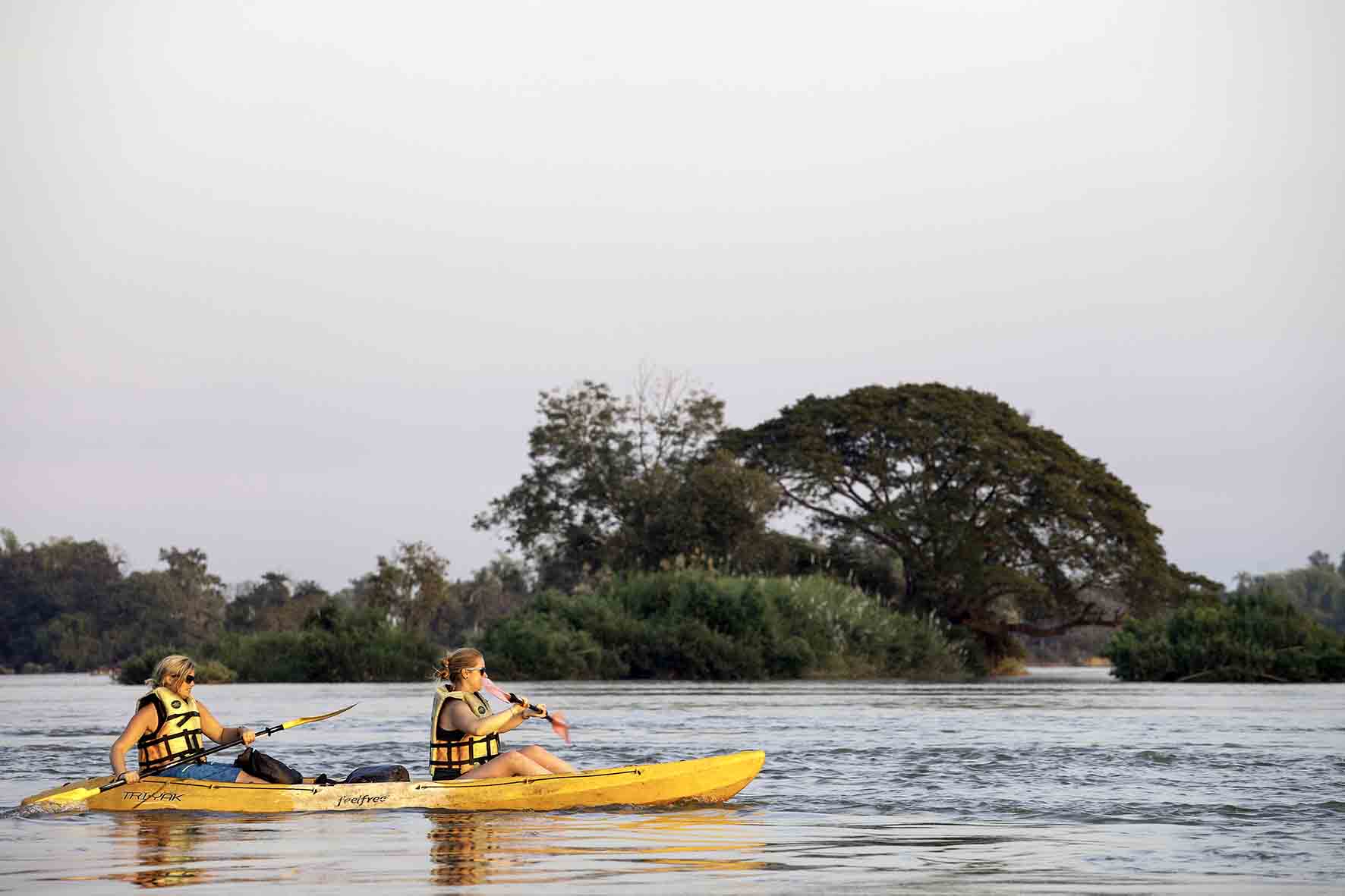
Green Paradise’s kayaking expedition wisely includes free breakfast for its mainly land-lubber clientele. After fuelling up with baguette, egg, and thick Lao coffee at a restaurant on Don Det island, we grabbed life jackets and tucked into our kayaks. Hoping to halve the work of paddling, I jumped into a kayak with our guide, Mr. Sam.
V Patient Mr. Sam spent a good deal of time barking ‘right, right’ as our crew of 21 – Brits, Australians, Dutch, French, and Hungarians – took to the water like ducks, I mean clumsy humans, grappling with kayak balance, water flow, and huge thickets of vegetation that reared up unexpectedly.
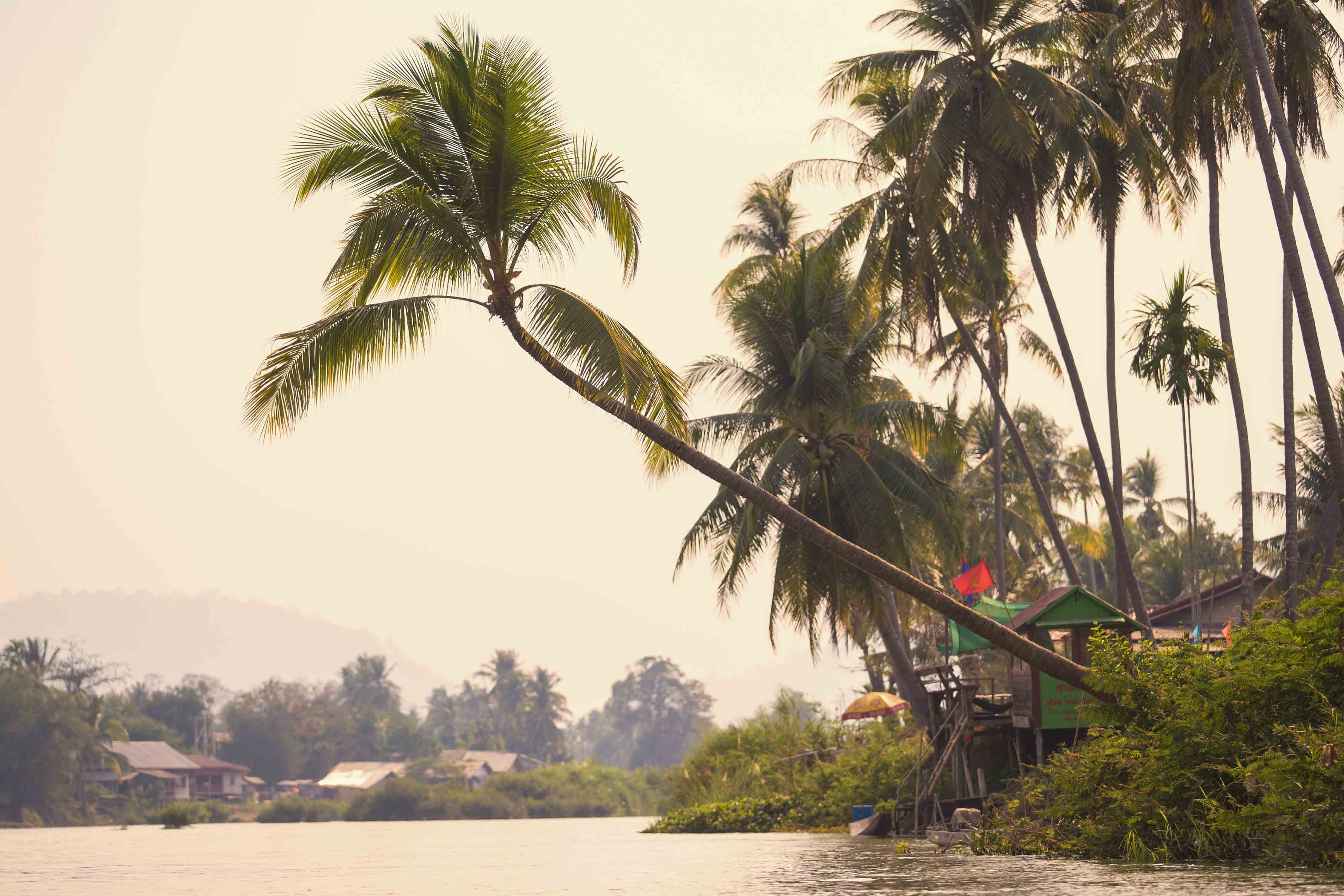
Our first destination was downstream at Don Khone Island’s Pa Soi rapids. Early on we temporarily lost part of the group, one kayak team fell into the river, and one kayak got sucked into a cluster of bushes and became entangled. The heat was unforgiving but we giggled at these mishaps and continued on our journey navigating clumps of trees and mini islands. We parked up just before Pa Soi rapids and walked over a bridge to look at the frothing water below.
The kayaks had been moved beyond Pa Soi Falls to a safe spot; we boarded them again for a journey to the bottom of Khone Island. At Hang Khone village, at the tip of Khone Island, we packed into a longtail boat to head upstream in search of the critically endangered Irrawaddy dolphin. We clambered up the sandy hill of a large island and looked across the stream of the fast-flowing river. The dolphins, their wet skin glistening in the sun, surfaced and ducked as they searched for fish in the food-rich pools. It was thrilling to catch a glimpse of these rare mammals. The WWF reports there’s been a slight increase in their numbers in the Mekong in Cambodia from 80 in 2015 to 92 in 2017 but not in Laos. In the Lao Mekong, there are just three. While munching on a lunch of baguette, chicken, and fried rice we saw all three of them about 30 to 40 times – all fins, snouts, sleek metal-grey bodies gleaming in the strong sun.
Back at Khone Island we fetched our kayaks and headed out downriver to a pickup point on the mainland at Ban Veunkham. The sun was crippling but, like a miracle, there on the riverbank at Ban Veunkham was a stall with a packed icebox. We cleaned it out of Beerlao and Coke before boarding a truck to visit the mother of all waterfalls – the kilometers-wide Khone Phapheng Falls.
At first sight, you can see why it defeated French colonial explorers. It’s a seething, frothing mass of thundering water swirling over sturdy boulders as it fights to enter Cambodia and the lower Mekong. The French found themselves in these parts when they were shoring up claims to the river and their Indochina colonies. The French needed to move gunboats into position to defend new territorial claims but navigating past the raging Khone Phapheng Falls – with its 21-meter drop – had defeated French minds. They built a railway across Khone Island, directly west of the Phapheng Falls, so two gunboats could be hauled across it; the railway infrastructure (some of which we saw at Hang Khone village) was later adapted for commercial traffic with steamboats on the river thrown into the mix. When roads were built in the 1930s the railway fell into disuse. Today, rusty locomotives stand abandoned at the edge of paddy fields, the last tangible remnants of island railway traffic.
After ice cream – more energy – we boarded our kayaks at Nakasang village to paddle downstream and back to Don Det Island. As the rose-pink sun began to set, the light was beautiful, the water appeared like silk, clumps of greenery took on a velvet glow, and fishermen were pootling about in pirogues.
Of course, after so much exercise, we replenished our muscles with more sundowner Beerlao as soon as we clambered back on to dry land!
GETTING THERE
Lao Airlines has daily flights to Pakse from Vientiane, Luang Prabang, and Bangkok. The 4000 Islands are 3 hours south of Pakse by road.
~The Laotian Times~
The 4000 Islands in southern Laos, low lying sandy clumps in the Mekong River, are famous for their easy-going pace, banana pancakes, afternoons in hammocks, dolphin-spotting opportunities, wide-sky sunsets, and raucous parties.
I’ve cycled over traces of the old French railway tracks through mango and teak forests, walked the slow loop of sandy trails wriggling through the islands’ small communities, and flitted about from one vestige of French power to another, to bar, to café, and guesthouse many times. I’d never considered taking to the water, though, until now.
The Mekong River can look formidable at times – a fast-flowing wide milk chocolate brown river cut with rocky islands and drowned trees. But a kayaking trip sounded exciting, and with a chance to spot the area’s rare Irrawaddy dolphins, too, I eagerly signed up.
Green Paradise’s kayaking expedition wisely includes free breakfast for its mainly land-lubber clientele. After fuelling up with baguette, egg, and thick Lao coffee at a restaurant on Don Det island, we grabbed life jackets and tucked into our kayaks. Hoping to halve the work of paddling, I jumped into a kayak with our guide, Mr. Sam.
V Patient Mr. Sam spent a good deal of time barking ‘right, right’ as our crew of 21 – Brits, Australians, Dutch, French, and Hungarians – took to the water like ducks, I mean clumsy humans, grappling with kayak balance, water flow, and huge thickets of vegetation that reared up unexpectedly.
Our first destination was downstream at Don Khone Island’s Pa Soi rapids. Early on we temporarily lost part of the group, one kayak team fell into the river, and one kayak got sucked into a cluster of bushes and became entangled. The heat was unforgiving but we giggled at these mishaps and continued on our journey navigating clumps of trees and mini islands. We parked up just before Pa Soi rapids and walked over a bridge to look at the frothing water below.
The kayaks had been moved beyond Pa Soi Falls to a safe spot; we boarded them again for a journey to the bottom of Khone Island. At Hang Khone village, at the tip of Khone Island, we packed into a longtail boat to head upstream in search of the critically endangered Irrawaddy dolphin. We clambered up the sandy hill of a large island and looked across the stream of the fast-flowing river. The dolphins, their wet skin glistening in the sun, surfaced and ducked as they searched for fish in the food-rich pools. It was thrilling to catch a glimpse of these rare mammals. The WWF reports there’s been a slight increase in their numbers in the Mekong in Cambodia from 80 in 2015 to 92 in 2017 but not in Laos. In the Lao Mekong, there are just three. While munching on a lunch of baguette, chicken, and fried rice we saw all three of them about 30 to 40 times – all fins, snouts, sleek metal-grey bodies gleaming in the strong sun.
Back at Khone Island we fetched our kayaks and headed out downriver to a pickup point on the mainland at Ban Veunkham. The sun was crippling but, like a miracle, there on the riverbank at Ban Veunkham was a stall with a packed icebox. We cleaned it out of Beerlao and Coke before boarding a truck to visit the mother of all waterfalls – the kilometers-wide Khone Phapheng Falls.
At first sight, you can see why it defeated French colonial explorers. It’s a seething, frothing mass of thundering water swirling over sturdy boulders as it fights to enter Cambodia and the lower Mekong. The French found themselves in these parts when they were shoring up claims to the river and their Indochina colonies. The French needed to move gunboats into position to defend new territorial claims but navigating past the raging Khone Phapheng Falls – with its 21-meter drop – had defeated French minds. They built a railway across Khone Island, directly west of the Phapheng Falls, so two gunboats could be hauled across it; the railway infrastructure (some of which we saw at Hang Khone village) was later adapted for commercial traffic with steamboats on the river thrown into the mix. When roads were built in the 1930s the railway fell into disuse. Today, rusty locomotives stand abandoned at the edge of paddy fields, the last tangible remnants of island railway traffic.
After ice cream – more energy – we boarded our kayaks at Nakasang village to paddle downstream and back to Don Det Island. As the rose-pink sun began to set, the light was beautiful, the water appeared like silk, clumps of greenery took on a velvet glow, and fishermen were pootling about in pirogues.
Of course, after so much exercise, we replenished our muscles with more sundowner Beerlao as soon as we clambered back on to dry land!
GETTING THERE
Lao Airlines has daily flights to Pakse from Vientiane, Luang Prabang, and Bangkok. The 4000 Islands are 3 hours south of Pakse by road.
~The Laotian Times~
2019年11月21日星期四
World Heritage Certificate for Plain of Jars
Laos Receives World Heritage Certificate for Plain of Jars
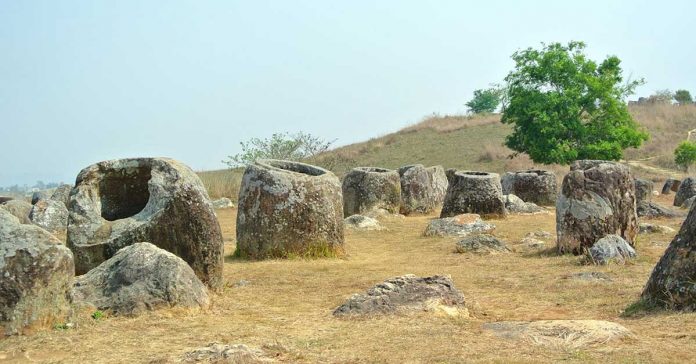
The UNESCO World Heritage Committee presented Laos with a certificate recognizing the World Heritage List designation of the Plain of Jars on Monday.
The Plain of Jars, situated on a plateau in Xieng Khuang Province, is named for the more than 2,100 tubular megalithic stone jars that are thought to have been used in the Iron Age for funeral practices.
Prof. Dr. Bosengkham Vongdara, with a special envoy of the Lao government, was presented with the award at the Forum of Ministers of Culture during the 40th session of the UNESCO General Conference held at the headquarters of UNESCO in Paris, France.
“We highly appreciate the role of UNESCO in fostering cultural diversity so that we can conserve and develop our own diverse and unique national culture and learn closely and constructively from each other,” said Prof. Dr. Bonsengkham Vondara when speaking at the certificate ceremony.
“In addition, our government is making a great effort to our heritage through tourism. By maintaining and opening up our cultural and historical sites, our aim is to grow and encourage cultural tourism, natural eco-tourism, and historical tourism.”

The Plain of Jars, formally called the Megalithic Jar Sites, was officially inscribed on the World Heritage List at a World Heritage Committee meeting held in Baku, Azerbaijan on July 10 this year, after submission in 2018.

Prof. Dr. Bosengkham Vongdara receives the Plain of Jars World Heritage Certificate in Paris, France.
The Plain of Jars is the third World Heritage Site in Laos. Luang Prabang, the former capital of Laos’s Lanexang Kingdom, was declared a World Heritage City in 1995, followed in 2001 by the site of Vat Phou in Champasack.
Xieng Khuang is situated 435 km north of Vientiane and is accessible by road or by air.
~Laotian Times~
The UNESCO World Heritage Committee presented Laos with a certificate recognizing the World Heritage List designation of the Plain of Jars on Monday.
The Plain of Jars, situated on a plateau in Xieng Khuang Province, is named for the more than 2,100 tubular megalithic stone jars that are thought to have been used in the Iron Age for funeral practices.
Prof. Dr. Bosengkham Vongdara, with a special envoy of the Lao government, was presented with the award at the Forum of Ministers of Culture during the 40th session of the UNESCO General Conference held at the headquarters of UNESCO in Paris, France.
“We highly appreciate the role of UNESCO in fostering cultural diversity so that we can conserve and develop our own diverse and unique national culture and learn closely and constructively from each other,” said Prof. Dr. Bonsengkham Vondara when speaking at the certificate ceremony.
“In addition, our government is making a great effort to our heritage through tourism. By maintaining and opening up our cultural and historical sites, our aim is to grow and encourage cultural tourism, natural eco-tourism, and historical tourism.”
The Plain of Jars, formally called the Megalithic Jar Sites, was officially inscribed on the World Heritage List at a World Heritage Committee meeting held in Baku, Azerbaijan on July 10 this year, after submission in 2018.
Prof. Dr. Bosengkham Vongdara receives the Plain of Jars World Heritage Certificate in Paris, France.
The Plain of Jars is the third World Heritage Site in Laos. Luang Prabang, the former capital of Laos’s Lanexang Kingdom, was declared a World Heritage City in 1995, followed in 2001 by the site of Vat Phou in Champasack.
Xieng Khuang is situated 435 km north of Vientiane and is accessible by road or by air.
~Laotian Times~
2019年2月17日星期日
Sayabouly Elephant Festival
THE ELEPHANT FESTIVAL
Venue: Sayabouly Province
Duration: 20-27 February
As living icon with important symbolic connotations and historical association in Laos the elephants an animal dear to the heart of the Lao people.
The Elephant Festival is celebrated specifically in Xayabouly Province and is held to demonstrate culture and traditional ties between Lao communities and elephants, as well as drawing attention to the endangered status of this charismatic species.
The Elephant Festival is a free, all-ages event with activities including a majestic elephant procession with up to 100 elephants, a traditional elephant Baci ceremony, fruit and flower offerings, monks’ blessing, mahout and elephant show. In addition, there are live performance from Lao and foreign artist, a night market and outdoor elephant museum.
Visitors will have the opportunity to see documentary film on a large outdoor screen and enjoy live performance on the main stage or go for an elephant drive in the neighbouring forest.
Useful Link: http://festival.elefantasia.org
Venue: Sayabouly Province
Duration: 20-27 February
As living icon with important symbolic connotations and historical association in Laos the elephants an animal dear to the heart of the Lao people.
The Elephant Festival is celebrated specifically in Xayabouly Province and is held to demonstrate culture and traditional ties between Lao communities and elephants, as well as drawing attention to the endangered status of this charismatic species.
The Elephant Festival is a free, all-ages event with activities including a majestic elephant procession with up to 100 elephants, a traditional elephant Baci ceremony, fruit and flower offerings, monks’ blessing, mahout and elephant show. In addition, there are live performance from Lao and foreign artist, a night market and outdoor elephant museum.
Visitors will have the opportunity to see documentary film on a large outdoor screen and enjoy live performance on the main stage or go for an elephant drive in the neighbouring forest.
Useful Link: http://festival.elefantasia.org
2019年1月28日星期一
Khammuan’s Tha Falang creating social media buzz
Khammuan’s Tha Falang creating social media buzz among visitors

KHAMMUAN (Vientiane Times/ANN) - The new Tha Falang development in Khammuan province is receiving lots of interest from domestic and international visitors after numerous pictures of the beautiful site have been shared on social media.
Located on the Nam Don river in Thakhaek district, the site opened last month ahead of this year’s scheduled commencement.
KK Transport and Service Company was authorised by Khammuan province to develop the site, which is located between Thock-Nayor and Songkhone villages.
A Memorandum of Understanding for the project was signed between the provincial Planning and Investment Department and the company in May last year. Company CEO Mr Khambee Lattanavong told Vientiane Times yesterday that Tha Falang was officially opened on December 8 after the company completed some facilities ahead of schedule.
“The facilities are designed to attract Europeans followed by Thai visitors,” he said.
The planned development sees the construction of 20 bungalows near the riverbank and 30 further inland as well as the provision of 100 kayaks for rent. The kayaks can be paddled over a 5km section of the river with motorboats also to be provided along with restaurants, a market, and other facilities.
Mr Khambee said the company was currently operating only some of the activities including 20 picnic huts near the riverbank, rental kayaks, a restaurant, and retail outlet.
He expected to build 20 more huts, and the bungalows will be completed in the next two months.
Kayaks cost 69,000 kip per person to rent or 85,000 kip for two people and 99,000 kip for three. Tubing rental is 20,000 kip and 50,000 kip for hut rental, while entrance and toilets are free of charge.
Tha Falang is currently attracting 100-150 visitors each weekday peaking at 300 on Saturdays and Sundays. Prior to the development, the site attracted only 50-60 people a day for swimming. Most of the visitors so far are Lao and Thai.
Tha Falang is 10 km from the centre of Thakhaek district. Khammuan is located in central Laos and borders Borikhamxay and Savannakhet provinces. Travel by private vehicle to the province takes 4-5 hours from Vientiane.

KHAMMUAN (Vientiane Times/ANN) - The new Tha Falang development in Khammuan province is receiving lots of interest from domestic and international visitors after numerous pictures of the beautiful site have been shared on social media.
Located on the Nam Don river in Thakhaek district, the site opened last month ahead of this year’s scheduled commencement.
KK Transport and Service Company was authorised by Khammuan province to develop the site, which is located between Thock-Nayor and Songkhone villages.
A Memorandum of Understanding for the project was signed between the provincial Planning and Investment Department and the company in May last year. Company CEO Mr Khambee Lattanavong told Vientiane Times yesterday that Tha Falang was officially opened on December 8 after the company completed some facilities ahead of schedule.
“The facilities are designed to attract Europeans followed by Thai visitors,” he said.
The planned development sees the construction of 20 bungalows near the riverbank and 30 further inland as well as the provision of 100 kayaks for rent. The kayaks can be paddled over a 5km section of the river with motorboats also to be provided along with restaurants, a market, and other facilities.
Mr Khambee said the company was currently operating only some of the activities including 20 picnic huts near the riverbank, rental kayaks, a restaurant, and retail outlet.
He expected to build 20 more huts, and the bungalows will be completed in the next two months.
Kayaks cost 69,000 kip per person to rent or 85,000 kip for two people and 99,000 kip for three. Tubing rental is 20,000 kip and 50,000 kip for hut rental, while entrance and toilets are free of charge.
Tha Falang is currently attracting 100-150 visitors each weekday peaking at 300 on Saturdays and Sundays. Prior to the development, the site attracted only 50-60 people a day for swimming. Most of the visitors so far are Lao and Thai.
Tha Falang is 10 km from the centre of Thakhaek district. Khammuan is located in central Laos and borders Borikhamxay and Savannakhet provinces. Travel by private vehicle to the province takes 4-5 hours from Vientiane.
2018年1月14日星期日
Public park planned for city’s riverside
Public park planned for city’s riverside
Vientiane authorities have agreed to the creation of a green lung for city residents and visitors in the form of a public park along the Mekong River in Sisattanak district.
The 31,500 square metre site is located behind the Don Chan Palace hotel and adjoins Chao Anouvong park.
According to the concession agreement signed on Monday between Vientiane’s Planning and Investment Department and Kolao Resort Company, the company will have a 30 year concession on the site. It is estimated that the park will cost US$10 million to build.
Kolao Group President Dr Khamkhan Naphavong told Vientiane Times on Wednesday “We will start work on the park this month and expect it to officially open in the middle of next year.”
“Under an agreement signed in March 2014, the project consisted only of a parking area, but that changed with the addition of more investment activities and budget with the aim of creating a leisure park. We signed the new agreement on Monday after it was approved by the Vientiane Mayor on January 5.”
“When construction is complete, the park will have a parking area, swimming pool, exercise area, children’s playground, modern food court and shops with facilities designed to attract tourists that will also sell handicrafts,” he said.
“The model has been designed and now we have to make a few adjustments. I hope the park will become another place that is attractive to visitors and provides a space where people can relax,” Dr Khamkhan added.
The Kolao Resort Company is also interested in developing part of Don Chan island next to the current concession site, where they are thinking of building a recreational water park. The company is ready to go ahead with this if the Vientiane authorities approve.
When asked about how the public could help to promote Visit Laos Year, Dr Khamkhan said litter was a major problem in Vientiane and places like Chao Anouvong park needed better management of cleaning.
Given that Vientiane is the capital and should be the flagship of the country’s attractions, with the Mekong riverbank fast becoming a magnet for visitors, the city should do more to roll out a welcome mat for Visit Laos Year, he said.
One of the places that draws visitors to the riverbank is Chao Anouvong park, which is very popular with local residents and people from outside the city.
The park is not only a place where people can go to stroll or exercise as they gaze at the sunset, it also has a bustling night market where people can buy a wide range of items, have a snack or buy a drink as they while away the evening in a relaxed setting.
~News courtesy of Vientiane Times~
Vientiane authorities have agreed to the creation of a green lung for city residents and visitors in the form of a public park along the Mekong River in Sisattanak district.
The 31,500 square metre site is located behind the Don Chan Palace hotel and adjoins Chao Anouvong park.
According to the concession agreement signed on Monday between Vientiane’s Planning and Investment Department and Kolao Resort Company, the company will have a 30 year concession on the site. It is estimated that the park will cost US$10 million to build.
Kolao Group President Dr Khamkhan Naphavong told Vientiane Times on Wednesday “We will start work on the park this month and expect it to officially open in the middle of next year.”
“Under an agreement signed in March 2014, the project consisted only of a parking area, but that changed with the addition of more investment activities and budget with the aim of creating a leisure park. We signed the new agreement on Monday after it was approved by the Vientiane Mayor on January 5.”
“When construction is complete, the park will have a parking area, swimming pool, exercise area, children’s playground, modern food court and shops with facilities designed to attract tourists that will also sell handicrafts,” he said.
“The model has been designed and now we have to make a few adjustments. I hope the park will become another place that is attractive to visitors and provides a space where people can relax,” Dr Khamkhan added.
The Kolao Resort Company is also interested in developing part of Don Chan island next to the current concession site, where they are thinking of building a recreational water park. The company is ready to go ahead with this if the Vientiane authorities approve.
When asked about how the public could help to promote Visit Laos Year, Dr Khamkhan said litter was a major problem in Vientiane and places like Chao Anouvong park needed better management of cleaning.
Given that Vientiane is the capital and should be the flagship of the country’s attractions, with the Mekong riverbank fast becoming a magnet for visitors, the city should do more to roll out a welcome mat for Visit Laos Year, he said.
One of the places that draws visitors to the riverbank is Chao Anouvong park, which is very popular with local residents and people from outside the city.
The park is not only a place where people can go to stroll or exercise as they gaze at the sunset, it also has a bustling night market where people can buy a wide range of items, have a snack or buy a drink as they while away the evening in a relaxed setting.
~News courtesy of Vientiane Times~
2017年3月23日星期四
Plain Of Jars: Unique Places Around The World
Plain Of Jars: Unique Places Around The World
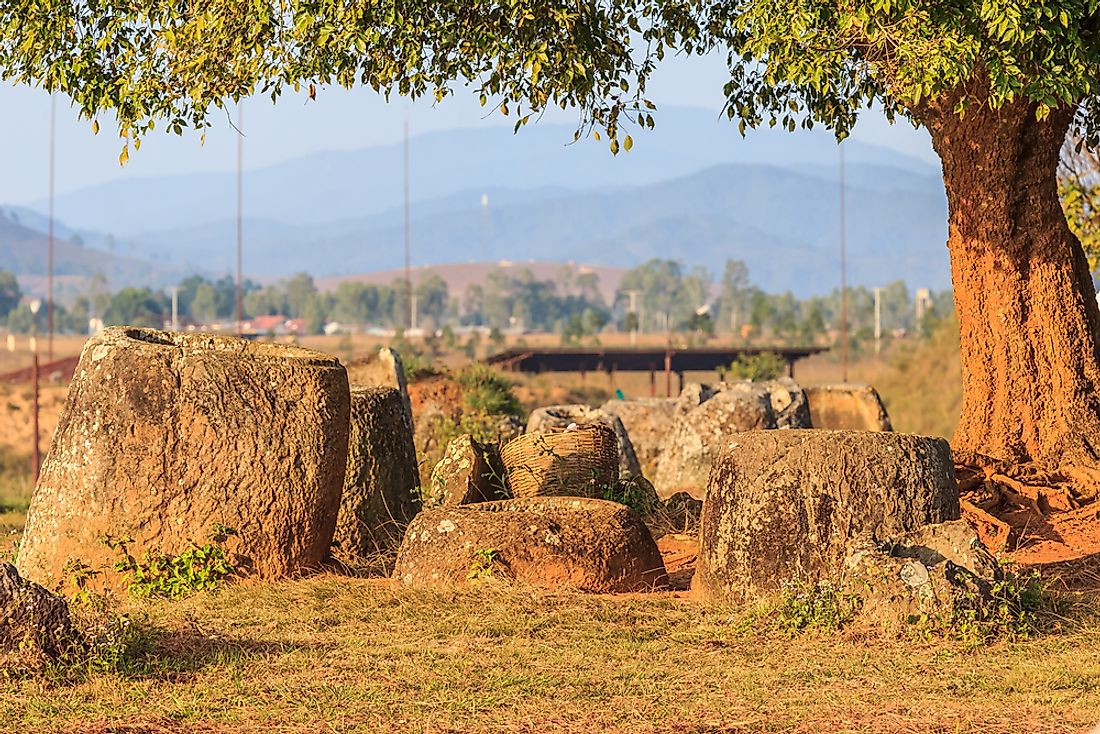
Plain of Jars is a large archaeological landscape found in Laos.

The Plain of Jars site.
The Plain of Jars is perhaps one of the most prolific sites in Laos. From overall aesthetics to the essential details, the plain symbolizes an oasis of ancient artifacts amid threats of a diminishing history around the region. Apart from being an established sanctuary, the Plain of Jars contributes majorly towards the economy. Although this nature reserve stands out as a major positive contributor towards the livelihood, it most certainly faces significant threats which may require future consideration.
5. Description

The Plain of Jars is located far in the northern regions of Annamese Cordillera, which is one of the largest mountain range in Southeast Asia. The archaeological landscape consists of various stones shaped in the form of jars. These beautiful jars are carefully arranged in a cluster-like manner. The distribution of the jars spans both the valley as well as the foothills in the mid-plain of Laos. It was not until 1930 that Madeleine Colani, a famous French researcher established that the jars came as a result of ancient burial practices. Excavation projects since then have confirmed this.
4. Tourism
Like many prehistoric sites, the Plain of Jars attracts many tourists from around the globe every year. This translates to a significant economic value regarding foreign exchange and other aspects such as international relationships. The breathtaking landscape acts as a distinct region where tourists come to quench their thirst for new experiences. The government has equally invested in the region by ensuring a safe and a convenient passage to the tourist site. There is a bus and air travel to the regions surrounding the plains. Although tourism in the region is still being fostered due to the bombings which occurred between 1964 to 1973, there are profound measures which have been put to restore the pride of the Plain of Jars.
3. Uniqueness
Even though there is substantial evidence to ascertain the origin of the jars in the region, the jars continue to carry an air of mystery. There is no clear fact that shows the maker of the jars and their reason. The bizarre collection of scattered jars in the plain is one of the unique sites one’s eyes meet upon visiting the plain. The presence of five different types of stones within the wall structure of the jars is also a startling occurrence that further serves to explore the uniqueness of the jars.
2. Habitat
The jars are mostly located in a plain which mostly has grass and scattered trees growing around them. Although the most attractive features about the plain are the jars, wildlife is also an occasional occurrence as small animals can be seen on the plains.
1. Threats

Between the years of 1964 to 1973, the U.S. Air Force bombed the Plain of Jars heavily in an effort against the communist forces of Pathet Lao and North Vietnam. A staggering amount of these bombs never exploded, and remain an active deadly threat in the area. As such, sightseeing can only be done on paths which have been clearly indicated. A program titled "Safeguarding the Plain of Jars" is a joint effort between Laos and the United Nations, with the intention to make the Plain of Jars safe enough to be a UNESCO Heritage Site.
~News courtesy of World Atlas~
Plain of Jars is a large archaeological landscape found in Laos.
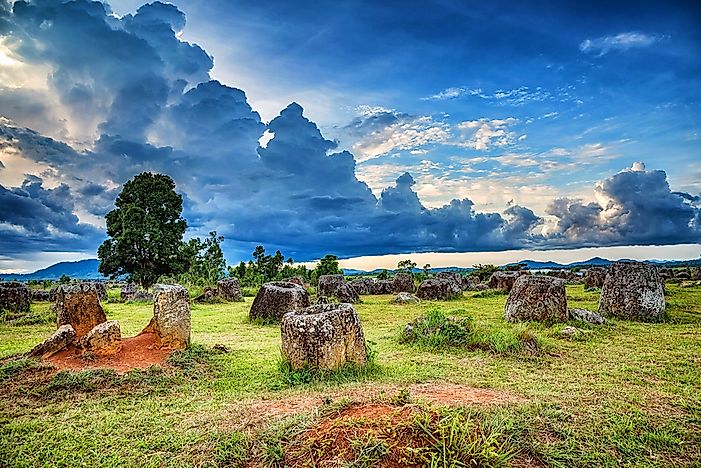
The Plain of Jars site.
The Plain of Jars is perhaps one of the most prolific sites in Laos. From overall aesthetics to the essential details, the plain symbolizes an oasis of ancient artifacts amid threats of a diminishing history around the region. Apart from being an established sanctuary, the Plain of Jars contributes majorly towards the economy. Although this nature reserve stands out as a major positive contributor towards the livelihood, it most certainly faces significant threats which may require future consideration.
5. Description
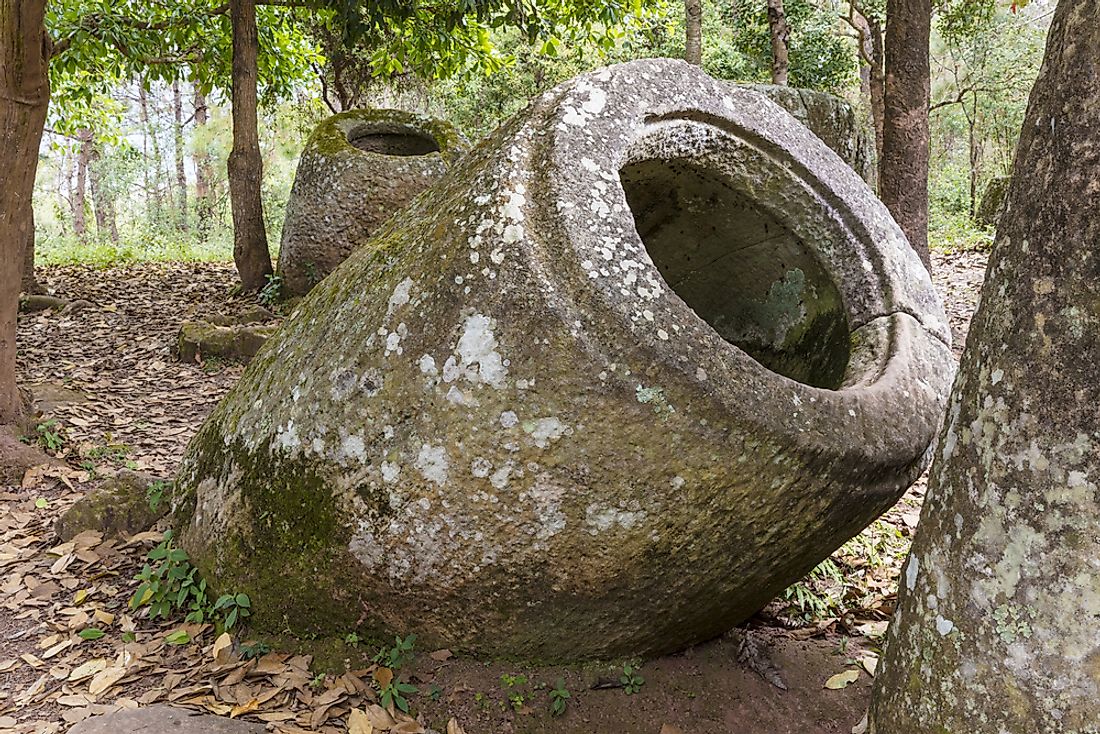
The Plain of Jars is located far in the northern regions of Annamese Cordillera, which is one of the largest mountain range in Southeast Asia. The archaeological landscape consists of various stones shaped in the form of jars. These beautiful jars are carefully arranged in a cluster-like manner. The distribution of the jars spans both the valley as well as the foothills in the mid-plain of Laos. It was not until 1930 that Madeleine Colani, a famous French researcher established that the jars came as a result of ancient burial practices. Excavation projects since then have confirmed this.
4. Tourism
Like many prehistoric sites, the Plain of Jars attracts many tourists from around the globe every year. This translates to a significant economic value regarding foreign exchange and other aspects such as international relationships. The breathtaking landscape acts as a distinct region where tourists come to quench their thirst for new experiences. The government has equally invested in the region by ensuring a safe and a convenient passage to the tourist site. There is a bus and air travel to the regions surrounding the plains. Although tourism in the region is still being fostered due to the bombings which occurred between 1964 to 1973, there are profound measures which have been put to restore the pride of the Plain of Jars.
3. Uniqueness
Even though there is substantial evidence to ascertain the origin of the jars in the region, the jars continue to carry an air of mystery. There is no clear fact that shows the maker of the jars and their reason. The bizarre collection of scattered jars in the plain is one of the unique sites one’s eyes meet upon visiting the plain. The presence of five different types of stones within the wall structure of the jars is also a startling occurrence that further serves to explore the uniqueness of the jars.
2. Habitat
The jars are mostly located in a plain which mostly has grass and scattered trees growing around them. Although the most attractive features about the plain are the jars, wildlife is also an occasional occurrence as small animals can be seen on the plains.
1. Threats
Between the years of 1964 to 1973, the U.S. Air Force bombed the Plain of Jars heavily in an effort against the communist forces of Pathet Lao and North Vietnam. A staggering amount of these bombs never exploded, and remain an active deadly threat in the area. As such, sightseeing can only be done on paths which have been clearly indicated. A program titled "Safeguarding the Plain of Jars" is a joint effort between Laos and the United Nations, with the intention to make the Plain of Jars safe enough to be a UNESCO Heritage Site.
~News courtesy of World Atlas~
2017年1月17日星期二
7 Things Not to Miss in Vientiane, Laos
7 Things Not to Miss in Vientiane, Laos

Situated on the banks of the Mekong river, Vientiane the capital of Laos is often overlooked by visitors in favor of more popular destinations such as Luang Prabang for outdoor activities, Luang Namtha for trekking or Vang Vieng to go tubing. Many people dismiss it as being boring and simply use Vientiane as a gateway to Laos when crossing the Friendship bridge from Nong Khai in Thailand. But actually Vientiane is a fascinating and unique melting pot of traditional Laos culture mixed with remnants of its time spent under French colonial rule.
Roads modeled on Parisian Rues and Boulevards are lined with street sellers peddling filled baguettes, as monks pass by dressed in brightly colored orange robes on their way to temple. European looking buildings house restaurants offering traditional Laotian dishes and games of petanque played by men old enough to recall French rule take place in the shadow of tropical palm trees. Here are 7 things not to miss in Vientiane:
1. Climbing up Patuxai
Positioned at the end of Lang Xang Avenue which is reminiscent of the Champs Elysees Paris, stands Patuxai Victory Monument. It’s an impressive looking archway that was built to commemorate those soldiers killed during World War II and during the war of independence from France in 1949.

Although often referred to as Vientiane’s Arc de Triomph, the detail of its architecture is traditional Laos with many Buddhist figures and symbols on display. For a small fee, you can climb the spiral staircase up to the top of the monument for panoramic views of the formal gardens below and out across much of Vientiane.
2. Visiting Pha That Luang

From the top of Patuxai looking North East you can make out the bright, shining form of Pha That Luang in the distance. Covered in gold leaf and shaped like a pyramid, it’s widely regarded as the most important religious monument in Laos and is breathtaking in its beauty. Also referred to as the Great Golden Stupa, it has been rebuilt various times in its history having been plundered for its gold and destroyed by wars on many separate occasions.
3. Down by the River at Night
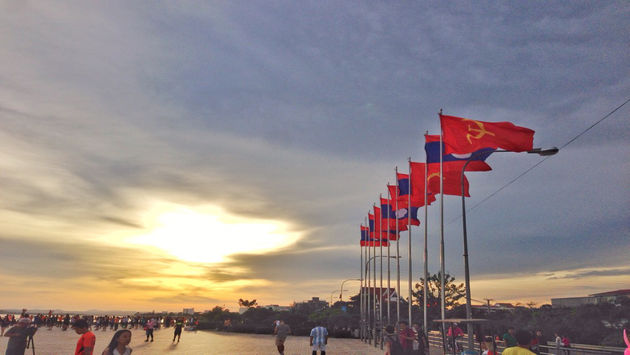
Just before dark, the area by the Mekong River turns into a bustling hub of activity. There are mass outdoor aerobics classes that take place at 6PM which you can join for under a dollar. Games of foot-volleyball take place in the sandy banks down below, and a vast night market springs up where you’ll find cheap clothes and souvenirs as well as food and drinks stalls. Many locals head down this way just to drink a beer and watch the sunset over the river which in itself is a truly unmissable experience when in Vientiane.
4. Witness Laos National Museum
Housed in an imposing colonial building, the interior of the Laos National Museum is slightly less impressive as it has definitely seen better days. That said, it’s a really interesting visit and certainly a unique blueprint for a national museum. Starting with prehistoric history and the relatively recent discovery of dinosaur bones in Laos, separate rooms run through the early history of the country before moving on to the various wars that have blighted its development in recent times. There are exhibitions of pottery, firearms and musical instruments and with Laos being one of the few countries in the world to remain under communist rule, it’s all narrated from a particularly partisan viewpoint which adds to the interest.
5. The Cope Visitor Center
Laos was severely affected by the Vietnam War and it’s estimated that there are up to 80 million un-exploded bombs that still remain strewn across the Laotian countryside today. As a result, around 50 people are injured or maimed by these bombs every year.

Cope is an incredible organization that provides help to those affected by these bombs, as well as by diseases such as Polio and Leprosy, by making prosthetic limbs and providing rehabilitation services. They have a brilliant visitor center in Vientiane which showcases their work and provides an insight in to the problems faced by thousands of people throughout the country. 6. Meditating with Monks
Wat Sok Pa Luang is a large temple located slightly outside of the center of Vientiane which offers the opportunity to try meditation with the young monks based here. It takes place every Saturday at 3 p.m. and is usually attended by about 10 monks and up to 20 visitors.

Many young monks use this as an opportunity to brush up on their English-speaking skills, and prior to the meditation is an hour of conversation with the monks where you’re able to learn more about their religion and culture. The meditation also lasts an hour and you’re instructed in sitting meditation and walking meditation techniques before an open Q&A where you can ask any remaining questions you may have.
7. Traditional Herbal Sauna and Massage
Just next door to Wat Sok Pa Luang is a traditional herbal sauna and massage center. It used to be located within the temple grounds but has now moved to the small woods that surround the Wat and offers a wood fired sauna as well as traditional massage available by the hour.
It’s a bit of a local secret with many Vientiane residents attending on a weekly basis so it can get quite crowded at peak times but it’s a friendly atmosphere and there’s an outdoor common space where you can chat and drink tea with new friends. If you’re able to set aside some time to spend in Vientiane, then it’s well worth staying for longer than the day that most visitors choose to spend. Elements of its culture are not found anywhere else in Laos, so before heading off to more rural areas in the Center and the North, make sure you explore the unique charms of the capital.
~Info courtesy of Travel Pulse~
Situated on the banks of the Mekong river, Vientiane the capital of Laos is often overlooked by visitors in favor of more popular destinations such as Luang Prabang for outdoor activities, Luang Namtha for trekking or Vang Vieng to go tubing. Many people dismiss it as being boring and simply use Vientiane as a gateway to Laos when crossing the Friendship bridge from Nong Khai in Thailand. But actually Vientiane is a fascinating and unique melting pot of traditional Laos culture mixed with remnants of its time spent under French colonial rule.
Roads modeled on Parisian Rues and Boulevards are lined with street sellers peddling filled baguettes, as monks pass by dressed in brightly colored orange robes on their way to temple. European looking buildings house restaurants offering traditional Laotian dishes and games of petanque played by men old enough to recall French rule take place in the shadow of tropical palm trees. Here are 7 things not to miss in Vientiane:
1. Climbing up Patuxai
Positioned at the end of Lang Xang Avenue which is reminiscent of the Champs Elysees Paris, stands Patuxai Victory Monument. It’s an impressive looking archway that was built to commemorate those soldiers killed during World War II and during the war of independence from France in 1949.
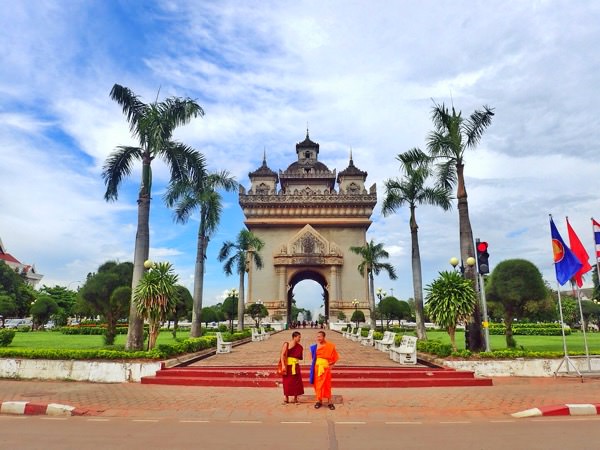
Although often referred to as Vientiane’s Arc de Triomph, the detail of its architecture is traditional Laos with many Buddhist figures and symbols on display. For a small fee, you can climb the spiral staircase up to the top of the monument for panoramic views of the formal gardens below and out across much of Vientiane.
2. Visiting Pha That Luang

From the top of Patuxai looking North East you can make out the bright, shining form of Pha That Luang in the distance. Covered in gold leaf and shaped like a pyramid, it’s widely regarded as the most important religious monument in Laos and is breathtaking in its beauty. Also referred to as the Great Golden Stupa, it has been rebuilt various times in its history having been plundered for its gold and destroyed by wars on many separate occasions.
3. Down by the River at Night
Just before dark, the area by the Mekong River turns into a bustling hub of activity. There are mass outdoor aerobics classes that take place at 6PM which you can join for under a dollar. Games of foot-volleyball take place in the sandy banks down below, and a vast night market springs up where you’ll find cheap clothes and souvenirs as well as food and drinks stalls. Many locals head down this way just to drink a beer and watch the sunset over the river which in itself is a truly unmissable experience when in Vientiane.
4. Witness Laos National Museum
Housed in an imposing colonial building, the interior of the Laos National Museum is slightly less impressive as it has definitely seen better days. That said, it’s a really interesting visit and certainly a unique blueprint for a national museum. Starting with prehistoric history and the relatively recent discovery of dinosaur bones in Laos, separate rooms run through the early history of the country before moving on to the various wars that have blighted its development in recent times. There are exhibitions of pottery, firearms and musical instruments and with Laos being one of the few countries in the world to remain under communist rule, it’s all narrated from a particularly partisan viewpoint which adds to the interest.
5. The Cope Visitor Center
Laos was severely affected by the Vietnam War and it’s estimated that there are up to 80 million un-exploded bombs that still remain strewn across the Laotian countryside today. As a result, around 50 people are injured or maimed by these bombs every year.
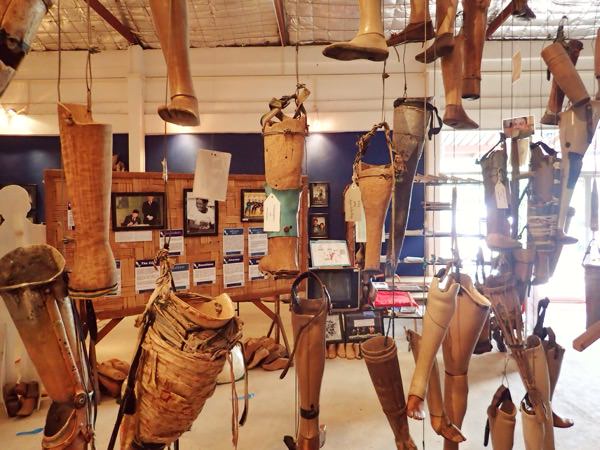
Cope is an incredible organization that provides help to those affected by these bombs, as well as by diseases such as Polio and Leprosy, by making prosthetic limbs and providing rehabilitation services. They have a brilliant visitor center in Vientiane which showcases their work and provides an insight in to the problems faced by thousands of people throughout the country. 6. Meditating with Monks
Wat Sok Pa Luang is a large temple located slightly outside of the center of Vientiane which offers the opportunity to try meditation with the young monks based here. It takes place every Saturday at 3 p.m. and is usually attended by about 10 monks and up to 20 visitors.

Many young monks use this as an opportunity to brush up on their English-speaking skills, and prior to the meditation is an hour of conversation with the monks where you’re able to learn more about their religion and culture. The meditation also lasts an hour and you’re instructed in sitting meditation and walking meditation techniques before an open Q&A where you can ask any remaining questions you may have.
7. Traditional Herbal Sauna and Massage
Just next door to Wat Sok Pa Luang is a traditional herbal sauna and massage center. It used to be located within the temple grounds but has now moved to the small woods that surround the Wat and offers a wood fired sauna as well as traditional massage available by the hour.
It’s a bit of a local secret with many Vientiane residents attending on a weekly basis so it can get quite crowded at peak times but it’s a friendly atmosphere and there’s an outdoor common space where you can chat and drink tea with new friends. If you’re able to set aside some time to spend in Vientiane, then it’s well worth staying for longer than the day that most visitors choose to spend. Elements of its culture are not found anywhere else in Laos, so before heading off to more rural areas in the Center and the North, make sure you explore the unique charms of the capital.
~Info courtesy of Travel Pulse~
2016年5月28日星期六
Tourist hordes put strain on Luang Prabang’s heritage
Tourist hordes put strain on Luang Prabang’s heritage
The enthusiasm of tourists for Luang Prabang’s heady charms has brought prosperity to the Lao town, but is the visitor influx damaging its cultural treasures?
The monks emerge shortly after six in the morning, smudges of flame in the predawn gloom. Alms bowls in hand, they walk silently through the town past Western-style cafés and restaurants. They pass boutique hotels with frangipani trees and soft white curtains covering the windows. Eventually, they turn onto Sisavangvong Road, Luang Prabang’s main drag, where a throng of tourists eagerly awaits.

Quick snap: tourists rush to take photographs of monks collecting alms in Luang Prabang. Photo: AP/David Longstreath
As the monks begin taking offerings from a line of Buddhist devotees, cameras are primed and the pack converges. One European man lights up the pavement with a huge flash on a tripod, filming monks as they step off a curb. Another walks up and down the line with a huge camera, pointing its black snout into the stream of saffron-clad novices and firing off machine-gun shutter-bursts.
For centuries, Luang Prabang’s monks have filed through these streets at dawn to collect alms from the local community. In more recent times, however, the morning ritual known as tak bat has ceded ground to another, noisier ritual – one of shutters and flashes and frenzied jostling for position along the crowded streets.
Each morning, tourism operators set up signs and tables, hawking coffee and overpriced sticky rice for tourists to ‘donate’ during the procession. Signs in six languages ask visitors to “respect the alms giving” and keep their distance from the monks, many of whom are novices, but these are routinely ignored.
For many, the tourist circus surrounding the tak bat encapsulates the negative side of a boom in visitors that has transformed the character of this Unesco-listed former royal capital. “It’s like a monkey troupe, it’s like a Disneyland,” says one prominent Laotian involved in cultural preservation efforts, who requested anonymity due to recent controversies over mass tourism and heritage issues. “We have [taken] action, we have made brochures, but I think it’s not enough.”
Luang Prabang’s old town, a temple-filled peninsula embraced by the Mekong and Nam Khan rivers, was once the capital of the Lan Xang kingdom, the fabled “Land of a Million Elephants”, and has remained the spiritual and religious centre of Laos in the centuries since.
Since being listed as a Unesco World Heritage Site in 1995, the town has gone from an impoverished settlement with a stuttering electricity supply to one of Southeast Asia’s prized boutique travel destinations. In 2015, this town of 50,000 attracted more than 445,000 international visitors, according to provincial tourism authorities, an increase of more than 10% on the previous year.
That figure may soon rise further following the opening up of new international air routes to the city. In March, the cut-price carrier AirAsia commenced regular flights from Bangkok, and HK Express has announced that it will add a flight from Hong Kong. Two additional airlines are awaiting approval for direct flights, according to recent media reports.
Now, two decades on from Luang Prabang’s Unesco listing, a milestone the city marked with a lavish street parade in December, many wonder whether it can maintain its traditions under the intensifying pressures of mass tourism.
As early as 2004, Unesco noted in a report that tourism development had already put a “critical stress” on the town’s environmental and cultural resources. Without proper management, it warned, Luang Prabang could well become “another tourist town where soft-drink billboards dominate the landscape, where the sound of tour buses drowns out the soft temple prayers and where the town’s residents are reduced to the roles of bit-players in a cultural theme park.”

Steely eye: a tourist shops for souvenirs made of scrap metal from fragments of bombs and war material. Photo: EPA/Barbara Walton
This dystopian vision has yet to come to pass, but there’s no denying the transformative effects of the tourist dollar. Gabriel Kuperman, the founder and director of the Luang Prabang Film Festival, now into its seventh year, says one effect of the boom has been families selling their houses in the old town to be converted into guesthouses and hotels.
“On one hand, it’s a positive thing that those families benefitted from a major injection of funds into their households,” says Kuperman. “On the other hand, now that there are fewer and fewer Lao families living in the heart of Luang Prabang, a certain amount of charm has been lost.”
Indeed, pockets of Luang Prabang are akin to portals into a sort of transnational Asian tourist space – a generic zone of souvenir shops, cheap travellers’ cafés, and the sort of gimmicky exotica encapsulated by the sight, on one recent evening, of an orchestra entertaining a crowd of foreigners with a rendition of “Auld Lang Syne” played on traditional Lao instruments. “There’s a point where it sort of kills the local life,” says Andrea Vinsonneau, the director of EXO Travel in Laos.
Locals express satisfaction at the influx of cash that tourism has brought, but also worry that the character of the city and its people have changed. “Some is good, some is bad,” says Chanthanom Soulatda, the owner of Villa Ban Lakkam, a guesthouse on the banks of the Nam Khan river. “Luang Prabang people are very calm, but now they run to make business,” the 71-year-old adds, standing on the street outside the guesthouse, which stands on the site of her childhood home. “Before they walked slowly, but now they run.”
Despite the accretions of global tourist culture, Luang Prabang has generally adhered to Unesco’s regulations, which include bans on demolitions within the heritage zone and the use of pane glass on buildings. The town remains low-slung and quiet, characterised by a delicate blend of Lao urban architecture and French colonial forms.
The difficulty, says Montira Horayangura Unakul, a national programme officer at Unesco in Bangkok, is that Luang Prabang’s most valuable heritage extends beyond the physical buildings to include “intangible” cultural practices and traditions – like the tak bat ceremony – which are not officially listed by Unesco. “The living aspects of the site are the really indispensable part of what makes Luang Prabang so distinctive,” she says.
This explains local anger at the touristification of the alms-giving ceremony – the central part of a living Buddhist culture. Phonesavan Bilavarn, 70, a retired English teacher whose childhood home still stands just off Sisavangvong Road, is livid: “They use the flash,” she says, miming the ‘chk, chk, chk’ of the shutterbugs, “and very close to the monks.”
Of course, some argue that Unesco is itself to blame for the changes that happen to World Heritage Sites such as Luang Prabang. The Italian writer Marco d’Eramo has argued that whenever a city is listed by Unesco, it “dies out, becoming the stuff of taxidermy, a mausoleum with dormitory suburbs attached”. Has World Heritage status saved Luang Prabang, only to rob it of its soul?
Rik Ponne, a former Unesco staffer and advisor to the Lao Ministry of Information, Culture and Tourism, says that such views oversimplify the complex challenge of balancing economic growth with cultural preservation. Taking a fundamentalist view on heritage issues, he argues, runs the risk of romanticising the poverty that allowed Luang Prabang to remain so “untouched” for so many decades.

The devoted: a young boy places sticky rice into a monk’s bowl. Photo: EPA/Barbara Walton
On the whole, Unakul says that in response to past criticisms from the World Heritage Committee, the Lao authorities have been “very proactive” in taking action to address its concerns and extending the development buffer zone around the old town. One of the current strategies for handling rising visitor numbers is to draw visitors away from the old town by promoting attractions further afield. “It’s definitely an issue that’s on a lot of people’s minds, and an issue that’s getting attention,” she says.
Vinsonneau, who has been living and working in Luang Prabang since 2000, says tourism operators also have a duty to educate their clients. EXO Travel provides each of its visitors with a handbook instructing them how to dress appropriately, how to interact with monks and how to behave during cultural events.
But she says that despite all the negative effects of mass tourism, the death of Luang Prabang’s soul has been greatly exaggerated, at least when compared with some of the other tourist hotspots of Southeast Asia.
“There’s still an incredible ambience,” Vinsonneau says of the town. “It’s good to remind people it could be much worse than this. It could be better, but it could be much worse.”
~News courtesy of Vientiane Times~
The enthusiasm of tourists for Luang Prabang’s heady charms has brought prosperity to the Lao town, but is the visitor influx damaging its cultural treasures?
The monks emerge shortly after six in the morning, smudges of flame in the predawn gloom. Alms bowls in hand, they walk silently through the town past Western-style cafés and restaurants. They pass boutique hotels with frangipani trees and soft white curtains covering the windows. Eventually, they turn onto Sisavangvong Road, Luang Prabang’s main drag, where a throng of tourists eagerly awaits.

Quick snap: tourists rush to take photographs of monks collecting alms in Luang Prabang. Photo: AP/David Longstreath
As the monks begin taking offerings from a line of Buddhist devotees, cameras are primed and the pack converges. One European man lights up the pavement with a huge flash on a tripod, filming monks as they step off a curb. Another walks up and down the line with a huge camera, pointing its black snout into the stream of saffron-clad novices and firing off machine-gun shutter-bursts.
For centuries, Luang Prabang’s monks have filed through these streets at dawn to collect alms from the local community. In more recent times, however, the morning ritual known as tak bat has ceded ground to another, noisier ritual – one of shutters and flashes and frenzied jostling for position along the crowded streets.
Each morning, tourism operators set up signs and tables, hawking coffee and overpriced sticky rice for tourists to ‘donate’ during the procession. Signs in six languages ask visitors to “respect the alms giving” and keep their distance from the monks, many of whom are novices, but these are routinely ignored.
For many, the tourist circus surrounding the tak bat encapsulates the negative side of a boom in visitors that has transformed the character of this Unesco-listed former royal capital. “It’s like a monkey troupe, it’s like a Disneyland,” says one prominent Laotian involved in cultural preservation efforts, who requested anonymity due to recent controversies over mass tourism and heritage issues. “We have [taken] action, we have made brochures, but I think it’s not enough.”
Luang Prabang’s old town, a temple-filled peninsula embraced by the Mekong and Nam Khan rivers, was once the capital of the Lan Xang kingdom, the fabled “Land of a Million Elephants”, and has remained the spiritual and religious centre of Laos in the centuries since.
Since being listed as a Unesco World Heritage Site in 1995, the town has gone from an impoverished settlement with a stuttering electricity supply to one of Southeast Asia’s prized boutique travel destinations. In 2015, this town of 50,000 attracted more than 445,000 international visitors, according to provincial tourism authorities, an increase of more than 10% on the previous year.
That figure may soon rise further following the opening up of new international air routes to the city. In March, the cut-price carrier AirAsia commenced regular flights from Bangkok, and HK Express has announced that it will add a flight from Hong Kong. Two additional airlines are awaiting approval for direct flights, according to recent media reports.
Now, two decades on from Luang Prabang’s Unesco listing, a milestone the city marked with a lavish street parade in December, many wonder whether it can maintain its traditions under the intensifying pressures of mass tourism.
As early as 2004, Unesco noted in a report that tourism development had already put a “critical stress” on the town’s environmental and cultural resources. Without proper management, it warned, Luang Prabang could well become “another tourist town where soft-drink billboards dominate the landscape, where the sound of tour buses drowns out the soft temple prayers and where the town’s residents are reduced to the roles of bit-players in a cultural theme park.”

Steely eye: a tourist shops for souvenirs made of scrap metal from fragments of bombs and war material. Photo: EPA/Barbara Walton
This dystopian vision has yet to come to pass, but there’s no denying the transformative effects of the tourist dollar. Gabriel Kuperman, the founder and director of the Luang Prabang Film Festival, now into its seventh year, says one effect of the boom has been families selling their houses in the old town to be converted into guesthouses and hotels.
“On one hand, it’s a positive thing that those families benefitted from a major injection of funds into their households,” says Kuperman. “On the other hand, now that there are fewer and fewer Lao families living in the heart of Luang Prabang, a certain amount of charm has been lost.”
Indeed, pockets of Luang Prabang are akin to portals into a sort of transnational Asian tourist space – a generic zone of souvenir shops, cheap travellers’ cafés, and the sort of gimmicky exotica encapsulated by the sight, on one recent evening, of an orchestra entertaining a crowd of foreigners with a rendition of “Auld Lang Syne” played on traditional Lao instruments. “There’s a point where it sort of kills the local life,” says Andrea Vinsonneau, the director of EXO Travel in Laos.
Locals express satisfaction at the influx of cash that tourism has brought, but also worry that the character of the city and its people have changed. “Some is good, some is bad,” says Chanthanom Soulatda, the owner of Villa Ban Lakkam, a guesthouse on the banks of the Nam Khan river. “Luang Prabang people are very calm, but now they run to make business,” the 71-year-old adds, standing on the street outside the guesthouse, which stands on the site of her childhood home. “Before they walked slowly, but now they run.”
Despite the accretions of global tourist culture, Luang Prabang has generally adhered to Unesco’s regulations, which include bans on demolitions within the heritage zone and the use of pane glass on buildings. The town remains low-slung and quiet, characterised by a delicate blend of Lao urban architecture and French colonial forms.
The difficulty, says Montira Horayangura Unakul, a national programme officer at Unesco in Bangkok, is that Luang Prabang’s most valuable heritage extends beyond the physical buildings to include “intangible” cultural practices and traditions – like the tak bat ceremony – which are not officially listed by Unesco. “The living aspects of the site are the really indispensable part of what makes Luang Prabang so distinctive,” she says.
This explains local anger at the touristification of the alms-giving ceremony – the central part of a living Buddhist culture. Phonesavan Bilavarn, 70, a retired English teacher whose childhood home still stands just off Sisavangvong Road, is livid: “They use the flash,” she says, miming the ‘chk, chk, chk’ of the shutterbugs, “and very close to the monks.”
Of course, some argue that Unesco is itself to blame for the changes that happen to World Heritage Sites such as Luang Prabang. The Italian writer Marco d’Eramo has argued that whenever a city is listed by Unesco, it “dies out, becoming the stuff of taxidermy, a mausoleum with dormitory suburbs attached”. Has World Heritage status saved Luang Prabang, only to rob it of its soul?
Rik Ponne, a former Unesco staffer and advisor to the Lao Ministry of Information, Culture and Tourism, says that such views oversimplify the complex challenge of balancing economic growth with cultural preservation. Taking a fundamentalist view on heritage issues, he argues, runs the risk of romanticising the poverty that allowed Luang Prabang to remain so “untouched” for so many decades.

The devoted: a young boy places sticky rice into a monk’s bowl. Photo: EPA/Barbara Walton
On the whole, Unakul says that in response to past criticisms from the World Heritage Committee, the Lao authorities have been “very proactive” in taking action to address its concerns and extending the development buffer zone around the old town. One of the current strategies for handling rising visitor numbers is to draw visitors away from the old town by promoting attractions further afield. “It’s definitely an issue that’s on a lot of people’s minds, and an issue that’s getting attention,” she says.
Vinsonneau, who has been living and working in Luang Prabang since 2000, says tourism operators also have a duty to educate their clients. EXO Travel provides each of its visitors with a handbook instructing them how to dress appropriately, how to interact with monks and how to behave during cultural events.
But she says that despite all the negative effects of mass tourism, the death of Luang Prabang’s soul has been greatly exaggerated, at least when compared with some of the other tourist hotspots of Southeast Asia.
“There’s still an incredible ambience,” Vinsonneau says of the town. “It’s good to remind people it could be much worse than this. It could be better, but it could be much worse.”
~News courtesy of Vientiane Times~
2016年5月13日星期五
Life in the slow lane - Luang Prabang
Life in the slow lane
How to spend 36 hours in Luang Prabang and still see everything without rushing
Amidst the breakneck pace of the surrounding region, Unesco-protected Luang Prabang is a haven for anyone wanting to escape a hectic lifestyle and discover the art of slow living. Dotted by faded villas and gilded temples, Luang Prabang, the ancient royal capital of the Lan Xang Kingdom, is the heart and soul of Laotian culture. The small town, where most locals are asleep by 11, is a fusion of traditional Lao architecture and the villas built by the European colonial authorities in the 19th and 20th centuries.
Sitting at the confluence of the Mekong and Khan rivers, Luang Prabang promises to wreck any tightly planned itinerary thanks to a way of life that allows residents and visitors to soak in the luxury of time.
FRIDAY
Dinner under the mango tree: 7pm
3 Nagas, a charming boutique hotel in the centre of Luang Prabang, is home to the award-winning "Best Lao Restaurant" in Luang Prabang. If there is no rain, dine outdoors under the huge mango tree and savour the beauty of the three restored historical houses. The restaurant serves one of the best Salad Pak Nam (watercress salad) in Luang Prabang. Another snack not to be missed while in Laos is river weed or kai with jaew bong, a sweet-and-spicy chilli paste made with chilli, galangal and water-buffalo skin.
Time to bargain: 9pm
Luang Prabang Night Market runs from 5 to 11. The street is closed off to vehicles from Sisavangvong Road to Settathilat Road in the town centre. The contrast between the sea of colourful knock-down stalls and the glittering backdrop of Haw Pha Bang and the Royal Palace Museum came as a shock to this visitor, who remembers a much more laid-back night stroll through a handful of vendors just 10 short years ago. The entire street is filled with vendors selling embroidered bags and purses, T-shirts, silk, cotton pants and shirts and paper lanterns. If walking and bargaining re-ignite your appetite, then head to the Night Food Market down the narrow lane at Settathilat Road where you'll find noodles, snacks, juice and the famous Beer Lao.
SATURDAY
Giving alms to monks: 6am
Giving sticky rice alms to hundreds of monks from more than 30 temples in Luang Prabang is a fascinating experience that shouldn't be missed, no matter what religion you may adhere to. Once the monks go back to their temples, the locals will take other dishes to eat with the rice to the temple so do not put any other comestibles than sticky rice in the bowl. Long sleeves worn with trousers or long skirts are recommended for all alms givers.
Coffee coffee coffee: 7am
Introduced by French colonialists in the early twentieth century, coffee has secured its place as the country's most famous drink and is also its largest agricultural export commodity. Pasaneyom Coffee Shop is one of the best places to enjoy an authentic Lao coffee, with a baguette (khao ji) or rice congee with youtiao (pah thong ko). If you prefer a more Western breakfast, check out Joma Bakery Cafe or Le Café Ban Vat Sene and enjoy your coffee while watching the world pass by.
Laotian whiskey and Pak Ou Cave: 9am
Ban Xang Hai or Whiskey Village, 29 km north of Luang Prabang, is a common stop on the boat ride to Pak Ou Cave and is just 30 minutes away by car. Laotian whiskey, or Lao Lao as it's known locally, is traditionally used in important blessing ceremonies and to greet visitors, so don't be surprised to be offered a shot of Laotian whiskey (or a jar with drinking straws to share!) as a welcome drink. Whiskeys bottled with snakes or scorpions, believed to have some medicinal benefits, are not for the faint-hearted. Taking a boat from Ban Xang Hai to Pak Ou Cave, a spot also known as Tham Ting, is a great way of recovering from the Laotian whiskey tasting. Tham Ting is a pair of centuries-old caves that are home to hundreds of small wooden Buddha images brought there by the boatmen for good luck.
Strolling or cycling, your choice: 1pm
With all the charm of a European town infused with the spirit of Asia, Luang Prabang is best discovered with a walk about town. A bicycle ride will speed up the travel time, giving more chances to visit attractions but less opportunity to enjoy the slow pace of the town.
> Places not to be missed are Wat Xiang Thong, Wat Wisunalat and the Royal Palace Museum.
Founded in 1560 by King Settathilat, Wat Xiang Thong, which sits alongside the river, is the finest example of Lao monastic architecture. The highlight is the Sim - the congregation hall - with its low, sweeping, three-tiered roof.
The original wood structure of Wat Wisunalat, alternatively known as Wat Visoun, was destroyed by the Black Flag invaders, but the That Makmo - the "watermelon stupa" - was rebuilt in the late 1920s.
The Royal Palace Museum or Golden Hall was built in 1904, when the French ran the country. A blend of European and Lao designs, the museum was the home of Sisavangvong, the last king of Laos, until his death in 1959. Haw Pha Bang or Royal Palace Chapel, located at the northeast corner of the Royal Palace Museum, houses Prabang, a golden Buddhist statue after which the town is named.
Sunset at Phu Si: 5am
Wat Phu Si or Pra That Phu Si is opposite the Royal Palace Museum, on the hill in the heart of Luang Prabang. The walk up, 328 steps, isn't easy, but is supposed to signify a test of faith. The summit offers some wonderful city views.
SUNDAY
Morning market: 6am
Don't miss the morning market in a web of alleys off Sisavangvong Road. You will find fresh vegetables, fruits, river weeds, buffalo skin, huge river fish, live and dead chickens (still with their feathers), beehives and honey bees, barbecued paddy mouse, snakes, bats and other, not always recognisable, produce spread out on bamboo mats on the sidewalk for good prices.
Ock Pop Tok: 10AM
Choose your favourite silk or learn how to weave your own fabric at Ock Pop Tok Living Crafts Centre, a place where weavers, spinners and batik makers produce top-quality fabrics. A tour of the centre gives a superb insight into silk production and dye making. Lunch at the centre's river-view cafe or try a cup of the pleasant silk-worm droppings tea.
IF YOU GO
ThaiAirAsia operates a daily flight between Bangkok's Don Mueang and Luang Prabang.
~News courtesy of The Nation~
How to spend 36 hours in Luang Prabang and still see everything without rushing
Amidst the breakneck pace of the surrounding region, Unesco-protected Luang Prabang is a haven for anyone wanting to escape a hectic lifestyle and discover the art of slow living. Dotted by faded villas and gilded temples, Luang Prabang, the ancient royal capital of the Lan Xang Kingdom, is the heart and soul of Laotian culture. The small town, where most locals are asleep by 11, is a fusion of traditional Lao architecture and the villas built by the European colonial authorities in the 19th and 20th centuries.
Sitting at the confluence of the Mekong and Khan rivers, Luang Prabang promises to wreck any tightly planned itinerary thanks to a way of life that allows residents and visitors to soak in the luxury of time.
FRIDAY
Dinner under the mango tree: 7pm
3 Nagas, a charming boutique hotel in the centre of Luang Prabang, is home to the award-winning "Best Lao Restaurant" in Luang Prabang. If there is no rain, dine outdoors under the huge mango tree and savour the beauty of the three restored historical houses. The restaurant serves one of the best Salad Pak Nam (watercress salad) in Luang Prabang. Another snack not to be missed while in Laos is river weed or kai with jaew bong, a sweet-and-spicy chilli paste made with chilli, galangal and water-buffalo skin.
Time to bargain: 9pm
Luang Prabang Night Market runs from 5 to 11. The street is closed off to vehicles from Sisavangvong Road to Settathilat Road in the town centre. The contrast between the sea of colourful knock-down stalls and the glittering backdrop of Haw Pha Bang and the Royal Palace Museum came as a shock to this visitor, who remembers a much more laid-back night stroll through a handful of vendors just 10 short years ago. The entire street is filled with vendors selling embroidered bags and purses, T-shirts, silk, cotton pants and shirts and paper lanterns. If walking and bargaining re-ignite your appetite, then head to the Night Food Market down the narrow lane at Settathilat Road where you'll find noodles, snacks, juice and the famous Beer Lao.
SATURDAY
Giving alms to monks: 6am
Giving sticky rice alms to hundreds of monks from more than 30 temples in Luang Prabang is a fascinating experience that shouldn't be missed, no matter what religion you may adhere to. Once the monks go back to their temples, the locals will take other dishes to eat with the rice to the temple so do not put any other comestibles than sticky rice in the bowl. Long sleeves worn with trousers or long skirts are recommended for all alms givers.
Coffee coffee coffee: 7am
Introduced by French colonialists in the early twentieth century, coffee has secured its place as the country's most famous drink and is also its largest agricultural export commodity. Pasaneyom Coffee Shop is one of the best places to enjoy an authentic Lao coffee, with a baguette (khao ji) or rice congee with youtiao (pah thong ko). If you prefer a more Western breakfast, check out Joma Bakery Cafe or Le Café Ban Vat Sene and enjoy your coffee while watching the world pass by.
Laotian whiskey and Pak Ou Cave: 9am
Ban Xang Hai or Whiskey Village, 29 km north of Luang Prabang, is a common stop on the boat ride to Pak Ou Cave and is just 30 minutes away by car. Laotian whiskey, or Lao Lao as it's known locally, is traditionally used in important blessing ceremonies and to greet visitors, so don't be surprised to be offered a shot of Laotian whiskey (or a jar with drinking straws to share!) as a welcome drink. Whiskeys bottled with snakes or scorpions, believed to have some medicinal benefits, are not for the faint-hearted. Taking a boat from Ban Xang Hai to Pak Ou Cave, a spot also known as Tham Ting, is a great way of recovering from the Laotian whiskey tasting. Tham Ting is a pair of centuries-old caves that are home to hundreds of small wooden Buddha images brought there by the boatmen for good luck.
Strolling or cycling, your choice: 1pm
With all the charm of a European town infused with the spirit of Asia, Luang Prabang is best discovered with a walk about town. A bicycle ride will speed up the travel time, giving more chances to visit attractions but less opportunity to enjoy the slow pace of the town.
> Places not to be missed are Wat Xiang Thong, Wat Wisunalat and the Royal Palace Museum.
Founded in 1560 by King Settathilat, Wat Xiang Thong, which sits alongside the river, is the finest example of Lao monastic architecture. The highlight is the Sim - the congregation hall - with its low, sweeping, three-tiered roof.
The original wood structure of Wat Wisunalat, alternatively known as Wat Visoun, was destroyed by the Black Flag invaders, but the That Makmo - the "watermelon stupa" - was rebuilt in the late 1920s.
The Royal Palace Museum or Golden Hall was built in 1904, when the French ran the country. A blend of European and Lao designs, the museum was the home of Sisavangvong, the last king of Laos, until his death in 1959. Haw Pha Bang or Royal Palace Chapel, located at the northeast corner of the Royal Palace Museum, houses Prabang, a golden Buddhist statue after which the town is named.
Sunset at Phu Si: 5am
Wat Phu Si or Pra That Phu Si is opposite the Royal Palace Museum, on the hill in the heart of Luang Prabang. The walk up, 328 steps, isn't easy, but is supposed to signify a test of faith. The summit offers some wonderful city views.
SUNDAY
Morning market: 6am
Don't miss the morning market in a web of alleys off Sisavangvong Road. You will find fresh vegetables, fruits, river weeds, buffalo skin, huge river fish, live and dead chickens (still with their feathers), beehives and honey bees, barbecued paddy mouse, snakes, bats and other, not always recognisable, produce spread out on bamboo mats on the sidewalk for good prices.
Ock Pop Tok: 10AM
Choose your favourite silk or learn how to weave your own fabric at Ock Pop Tok Living Crafts Centre, a place where weavers, spinners and batik makers produce top-quality fabrics. A tour of the centre gives a superb insight into silk production and dye making. Lunch at the centre's river-view cafe or try a cup of the pleasant silk-worm droppings tea.
IF YOU GO
ThaiAirAsia operates a daily flight between Bangkok's Don Mueang and Luang Prabang.
~News courtesy of The Nation~
2016年4月29日星期五


2016年4月12日星期二


2016年4月9日星期六
Sand sculptures help mark Pi Mai Lao
Sand sculptures help mark Pi Mai Lao
Sand sculptures on Don Chan Beach near the Mekong River in Vientiane are nearing completion for annual Pi Mai Lao celebrations from April 13-16 with authorities expecting large crowds.

An elephant sand sculpture taking shape for Pi Mai Lao celebrations.
Contractor MsRatsadapornBusadee told Vientiane Times on Tuesday that the sand sculpting project commenced on March 8 and will be completed by this Sunday.
This year's theme is the AEC and Laos chairing Asean with artists from Laos and Thailand working together to create the sand sculptures on the Mekong River beach.
“This time there will be 15 sand sculptures focusing on the symbols of the 10 countries in Asean, especially the symbols of Laos such as the elephant and That Luangstupa,” MsRatsadaporn said.
“Last year almost 100,000 visitors saw the sand sculptures on Don Chan Beach and this time we expect even more visitors than last year,” she said.
Admission to the sand sculpture area is 10,000 kip per person with children aged under five free of charge.
During Pi Mai Lao celebrations the riverside area will host many activities such as beach football and volleyball, boxing, traditional fashion shows, concerts and stalls selling an enticing array of goods.
According to the Vientiane authority, there would be a special water pouring ceremony for older people and visitors in the area of Vat Chan up to the beach alongside Khounta village in Sikhottabong district.
This year marks the 450th anniversary of the building of Vat That Luang, which would be reflected in the festivities.
However, people from other provinces around the country will also be enjoying Pi Mai Lao, especially traditional activities such as pouring water over Buddha images.
~News courtesy of Vientiane Times~
Sand sculptures on Don Chan Beach near the Mekong River in Vientiane are nearing completion for annual Pi Mai Lao celebrations from April 13-16 with authorities expecting large crowds.

An elephant sand sculpture taking shape for Pi Mai Lao celebrations.
Contractor MsRatsadapornBusadee told Vientiane Times on Tuesday that the sand sculpting project commenced on March 8 and will be completed by this Sunday.
This year's theme is the AEC and Laos chairing Asean with artists from Laos and Thailand working together to create the sand sculptures on the Mekong River beach.
“This time there will be 15 sand sculptures focusing on the symbols of the 10 countries in Asean, especially the symbols of Laos such as the elephant and That Luangstupa,” MsRatsadaporn said.
“Last year almost 100,000 visitors saw the sand sculptures on Don Chan Beach and this time we expect even more visitors than last year,” she said.
Admission to the sand sculpture area is 10,000 kip per person with children aged under five free of charge.
During Pi Mai Lao celebrations the riverside area will host many activities such as beach football and volleyball, boxing, traditional fashion shows, concerts and stalls selling an enticing array of goods.
According to the Vientiane authority, there would be a special water pouring ceremony for older people and visitors in the area of Vat Chan up to the beach alongside Khounta village in Sikhottabong district.
This year marks the 450th anniversary of the building of Vat That Luang, which would be reflected in the festivities.
However, people from other provinces around the country will also be enjoying Pi Mai Lao, especially traditional activities such as pouring water over Buddha images.
~News courtesy of Vientiane Times~
2016年1月14日星期四


订阅:
博文 (Atom)